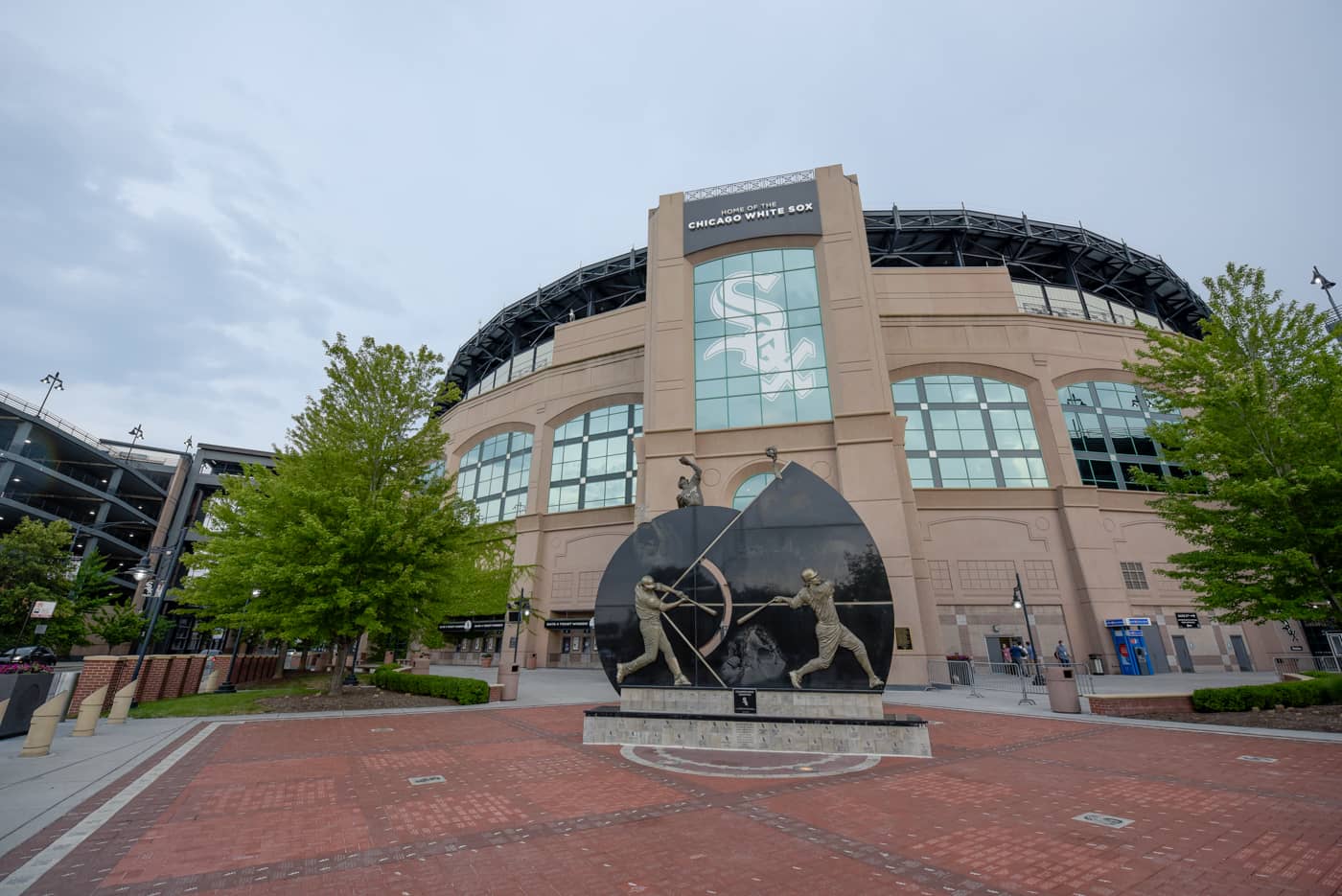
A leadership vacuum creates yet another chaotic stadium issue in the nation’s greatest sports town
One thing Chicago’s so-called “leaders” haven’t managed to ruin just yet is its status as one of America’s great sports towns.
Da Bears. The Cubs. The White Sox. The Bulls. The Blackhawks. The Fire. Generations of Chicagoans have inherited these teams almost as family property. Political administrations come and go, neighborhoods change, businesses open and close, but Chicago sports endure.
Which is why decisions about where these franchises play and real-estate transactions are not merely. They involve transportation, neighborhoods, development, taxpayer money, civic identity, and billions of dollars of private and public investment. They demand something more from City Hall than another listening session and another statement about “centering” everybody’s voice.
Yet Chicago has arrived at another major stadium controversy with “Mayor” Brandon Johnson (aka the Notorious MBJ) occupying approximately the same position he has occupied on so many difficult questions: on the outside looking in.
The latest controversy concerns the future home of the Chicago White Sox. White Sox minority owner and potential future controlling owner Justin Ishbia has unveiled an intriguing proposal called The Railyards, a 47-acre redevelopment of Amtrak property along the Chicago River between Roosevelt Road and 18th Street. The proposed development could include a spectacular new White Sox ballpark with the skyline beyond the outfield, water-taxi access, a possible nearby Metra station, housing, retail and commercial development, plus a Northwestern Medicine presence.
On paper, it is easy to see the appeal. The Chicago Tribune’s Paul Sullivan waxed rhapsodic about an open-air riverfront ballpark with the still magnificent skyline as a dramatic backdrop the fans and TV cameras would love, far more aesthetically appealing than the current view of the prosaic South Side.
The Sox lease at Rate Field expires in 2029, although an extension is possible, which means the franchise has a legitimate reason to begin considering its long-term future now. Ishbia’s company has the Amtrak property under contract, although the proposal remains in the early stages and is undergoing transportation, environmental, and feasibility studies
Unlike the Bears stadium fiasco, this one isn’t really all about the money at least in terms of public subsidies: according to both Chicago Sun-Times and Chicago Tribune reporting, the proposed ballpark itself would be privately financed. Public assistance could still be requested for surrounding infrastructure — roads, bridges, and potentially a Metra station — but this is not presently being pitched as simply handing taxpayers the construction bill for a billionaire’s baseball stadium.
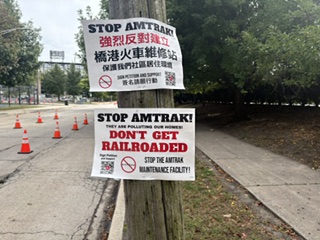
This controversy is a neighborhood story. In addition to the traumatic loss of the White Sox, a neighborhood institution for 116 years, there is another cross for the Bridgeport residents to bear. To free the South Loop property for redevelopment, Ishbia wants Amtrak to move its maintenance operations to a site near Rate Field in Bridgeport. Amtrak has received hundreds of millions of dollars in federal funding for a new Midwest maintenance facility there. The facility would operate around the clock, and residents of Bridgeport, Chinatown, and Armour Square have reacted with something considerably stronger than polite skepticism.
Hundreds have turned out to protest. At a September 17 community meeting, according to Tribune reporting, an overflow crowd loudly rejected Amtrak’s proposal, with residents raising concerns about pollution, noise, and the proximity of railroad operations to homes. Labor representatives countered that the project would generate thousands of construction jobs. In other words, there are legitimate interests on both sides.
Nicole Lee, whose 11th Ward includes Rate Field and to some extent personifies the 21st century ethnographic change in this ancient Chicago neighborhood, has come out forcefully against the proposal. She argues the 35-year-old ballpark has plenty of useful life remaining and the surrounding 35th Street area should instead be redeveloped and modernized. She has been even more emphatically opposed to putting the 24-hour Amtrak maintenance operation next to a residential community.
The Illinois Sports Facilities Authority, which owns Rate Field, has also taken a position. Chair Leslie Darling said the authority’s “main priority” is keeping the White Sox where they are, although she acknowledged the team has every right to explore alternatives as its lease approaches expiration.
Ishbia also has a legitimate position. His argument is essentially that an underutilized industrial property on the Chicago River can be transformed into a major mixed-use development incorporating health care, housing, businesses, and a modern ballpark. That is not facially absurd. Indeed, it could represent precisely the sort of private investment Chicago desperately needs.
The White Sox also have a right to ask whether Rate Field, opened in 1991, is the best home for the franchise for another generation.
Reasonable people can disagree about the answer. Should Rate Field be renovated? Should the neighborhood around it finally be developed into something worthy of a major-league franchise? Should the Sox move to The Railyards? Should public money be used for infrastructure supporting a privately financed stadium? Where should Amtrak locate a maintenance facility that it says is necessary to improve its Midwest operations? What protections should nearby residents receive?
Those are real questions. They require somebody to balance competing interests and attempt to hammer out a solution to forge a compromise that is best for the city. That is what makes this an actual leadership problem rather than an opportunity for another slogan.
It’s precisely the kind of issue that calls for a strong leader in the mold of Richard J. Daley to rise to the occasion. Instead, we are cursed with “Mayor” Brandon Johnson. When reporters asked Johnson whether he supports Ishbia’s proposed stadium, the mayor called it “just a concept.”
"No official decision has been made here,” Johnson said. “I think it’s important that we center the voices of the community around any type of economic development.” What exactly that means is anybody’s guess. A reasonable translation would be: This won’t put any money in Stacy Davis-Gates’ Chicago Teachers’ Union purse, so I don’t give a damn.
Asked about the proposal and potential TIF assistance, Johnson again declined to take a position. Instead, he once again played the artful dodger — quoteth the “Mayor” — “community voice has to be centered in all of this;” he then made the absurd assertion that the proposal demonstrated business confidence in Chicago and his administration. The only good thing about this goofball is he doesn’t need a laugh track.
In typical Notorious MBJ fashion, this little farce bordering on tragedy miserably failed to answer any of the burning questions. Does the mayor want the White Sox to remain at 35th Street? Does he prefer The Railyards? Does he oppose moving Amtrak operations next to Bridgeport homes? Would he support infrastructure subsidies if Ishbia privately finances the stadium? Would he use city authority to help block the Amtrak relocation? What does Chicago want? Most importantly, what’s best for this city? That’s the mayor’s job. As usual, he is abdicating responsibility. It’s as if he’s never even read the job description. Perhaps he relies on the cheat sheet the CTU prepared.
Nobody is asking the mayor to issue building permits tomorrow morning. The Railyards proposal is preliminary. Environmental and transportation studies have not been completed. Negotiations have barely begun. But leadership does not require knowing every answer before announcing a governing objective. He could start bringing the parties into a room. That is what mayors traditionally do.
This is particularly important because Chicago has already spent years watching another marquee franchise wander through its own stadium odyssey. The Bears have considered Soldier Field, Arlington Heights, and now seem serious about joining the taxpayer exodus to redder pastures in Hoosierville. Johnson previously backed a lakefront stadium proposal in 2024, but the larger stadium issue remains unresolved. As the 2027 campaign gets underway, the future of the Bears is again emerging as a major civic and political issue.

Nowhere come the White Sox, and rather than learning from history, His Royal Stupidity is dooming us to repeat it; once again Chicago once again fiddles, allowing private developers, franchise owners, state agencies, federal agencies, aldermen, and neighborhood organizations to establish their positions while City Hall explains that everyone’s voice must be heard. Thank you, Captain Obvious! Of course everyone should be heard. Then somebody has to lead.
Alexi Giannoulias is no better. He has sounded similarly timid on the controversy. Asked whether Bridgeport residents could count on him to oppose the maintenance facility move, Giannoulias said residents deserve transparency and answers while stopping short of joining officials demanding that Amtrak abandon the plan. He has also emphasized economic development and keeping Chicago’s sports franchises in Chicago. That may be politically expedient, but it’s not the bold leadership Chicago needs.
The irony is that the ingredients for an extraordinary Chicago development may actually be hiding in plain sight. Imagine a privately financed Bears stadium overlooking the Chicago River, surrounded by housing, businesses, and medical facilities, across the river from the new Chicago Fire stadium at The 78. The Fire project itself is privately financed by owner Joe Mansueto, although the surrounding development is benefiting from substantial TIF-funded infrastructure, and a renovated Rate Field amidst a transformed neighborhood where a renaissance in public safety, the prerequisite to prosperity, forms the foundation of a genuine entertainment and commercial district. This would keep the Sox rooted in the neighborhood they have called home for generations, and re-engineers Amtrak into a neighbor-friendly asset vs. a perceived liability that does not provoke a neighborhood revolt.
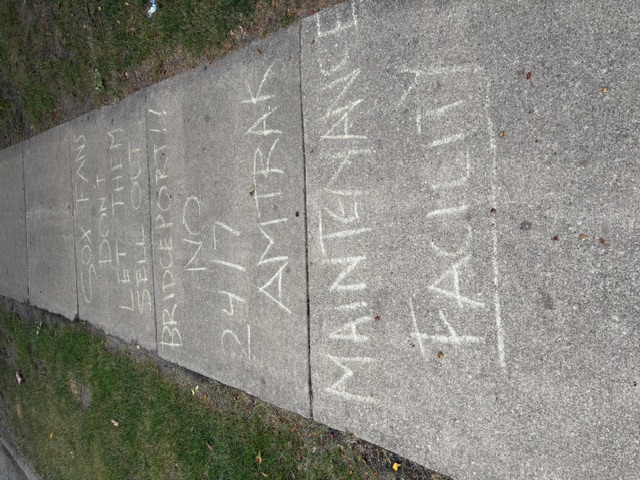
Instead, a guerrilla war against White Sox ownership has been declared which reportedly includes a sudden uptick in health inspections of the Rate, a time-honored City Hall pressure tactic, as well as the usual press conferences, sidewalk chalk, and resident protest signage targeting Sox fans to put pressure on ownership.
That is why the central issue is not whether Justin Ishbia is right, Nicole Lee is right, Amtrak is right or the residents protesting outside Rate Field are right. It is whether Chicago possesses the civic leadership capable of forcing all of those competing interests toward an answer. Chicago is supposed to be the City of Big Shoulders. It is certainly a city of big sports franchises. Big cities face big decisions, and eventually somebody at City Hall has to make them.
MBJ is incapable of taking responsibility for anything. He’s a blamer with no vision other than to fill the CTU’s insatiable greed. So it’s time for Chicago to make a decision. It’s time for him to go! In politics, as in baseball, three strikes and you’re out, and this clown is the strikeout king.
