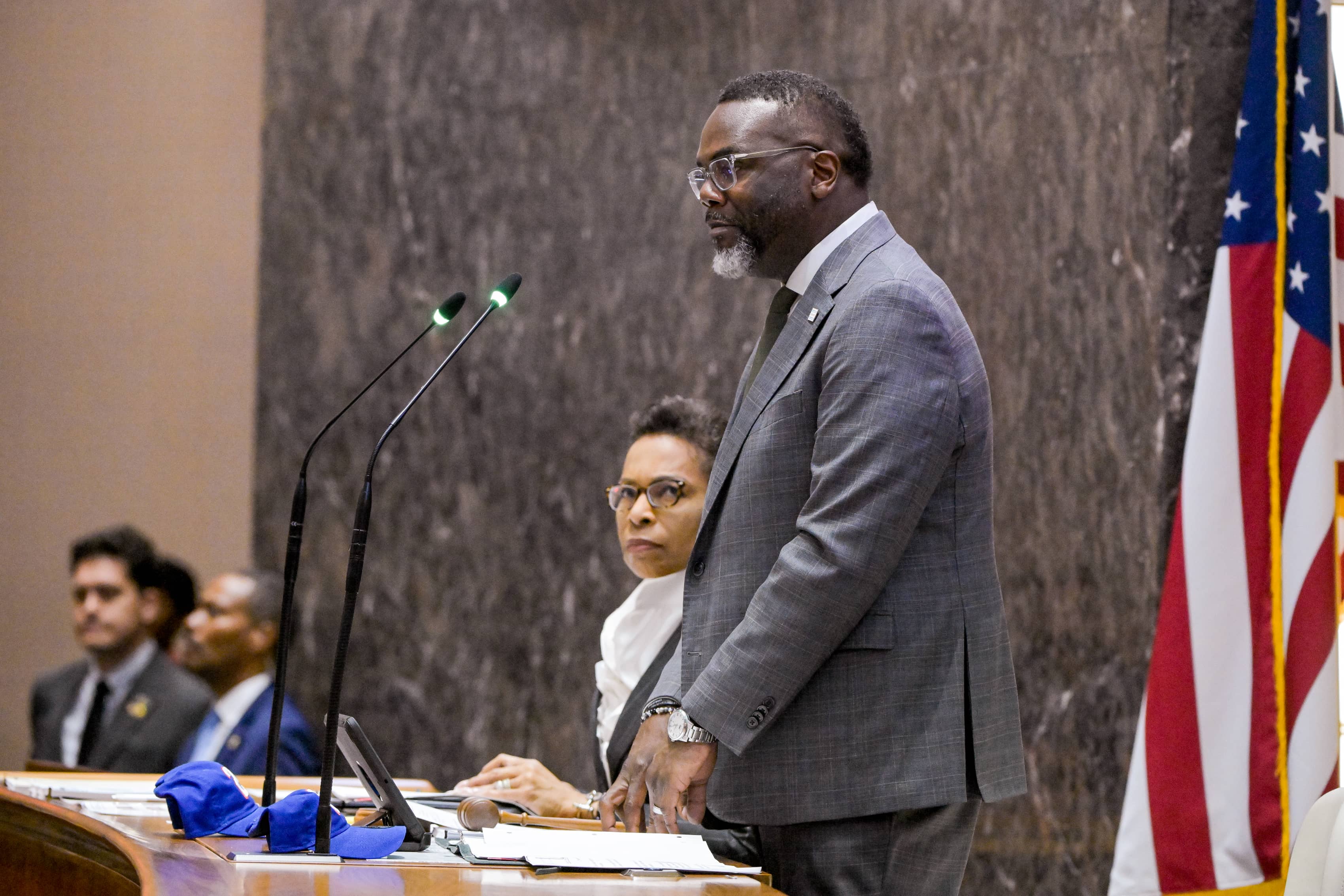
With neither the will nor expertise to address the spending side of the city’s financial crisis, Mayor Johnson resorts to blaming his critics in the City Council
Chicago Mayor Brandon Johnson has significantly escalated political attacks against his critics in the Chicago City Council. As both sides gear up for a contentious budget season, Johnson has weaponized public forums to censure them and label them the “Corporate Caucus.” While the tension between the executive office and the City Council has been described by some as a historic shift away from Chicago’s traditional "rubber-stamp" mayoral politics, it is far from it. Rather, it reflects the mayor’s need to scapegoat aldermen who oppose his heedless spending, administrative failures, and fiscal incompetency.
With the exception of crime rates — which have fallen nationwide — the mayor’s claims of improving the local economy, investing in affordable housing, improving public schools, and making Illinois more affordable are largely illusory. Even with recent dips in violent crime indices, Chicago remains a national leader in homicides, attempted murders, youth shootings, and mass incidents. Meanwhile, city residents are reeling from over $1 billion in combined city and school district tax and fee increases, with residential property owners absorbing massive spikes in their local tax burdens.
In need of a villain, the mayor has escalated political attacks against his critics within the City Council, claiming a "Corporate Caucus" serves as the primary obstacle to a balanced budget and unleashing progressive revenue. Prominent Johnson allies, such as Alderman Rossana Rodríguez-Sánchez (33) and Congresswoman Delia Ramirez (IL-5), have gone so far as to label lifelong Democratic aldermen who opposed Johnson’s head tax as "fascists." Far from being a tax on the wealthy, the job-killing proposal would have taxed city businesses based strictly on their headcount, regardless of net operating income.
The mayor is attempting to portray his City Council critics as captives of corporate interests. Yet the fact remains the City Council has largely continued a five-decade tradition of rubber-stamping the executive branch’s budget and legislative agenda. Their only acts of successful, major defiance were rejecting the mayor’s proposed $300 million property tax increase in his second budget cycle, followed by their rejection of his proposed $100 million corporate "head tax."
Other than blocking those two measures, City Council has acted as a rubber stamp, approving or declining to contest nearly every other item in Johnson’s revenue increase and spending plans. This includes approving dozens of secondary tax and fee hikes, spending $639 million, over $300 million from city sources, for migrant housing and support services, and providing the school district with over $1 billion in property tax revenues from TIFs to pay for a record CTU contract. The $1 billion in TIF surplus accompanied the mayor-controlled school board approving a $752 million increase in its property tax levy.
There is little City Council monitoring on city spending. For example: City COVID spending, outlays on Community Violence Interrupters, and expenditures to accommodate migrants have all been fraught with controversy. More troubling, the transfer of emergency responses from police and fire to the city’s Crisis Assistance Response and Engagement (CARE) program under the Chicago Department of Public Health led to the dispatch volume plummeting by nearly 70 percent its second year. A steady decrease in responses continued thereafter. Most concerning is the complete absence of any form of transparency or accountability for school district spending, despite Chicago providing annual subsidies in the amount of $1.3 billion.
Meanwhile, Chicago has systematically reduced budgeted police strength by declining to fill police vacancies. According to former CPD Superintendent Larry Snelling, the Chicago Police Department is 2,000 officers below full strength. Little wonder half of “High Priority” 911 calls do not receive an immediate response and why the arrest rate for violent crimes remain in single digits. Note the Mayor’s false claim that arrest rates are improving because he added the 200 new detectives he promised through promotion. A falsehood, because retirements among the detective ranks have increased, the actual detective strength has increased by fewer than 50.
By choice, the City Council lacks the necessary staff, resources, and independent data access to effectively challenge mayoral budgets or monitor spending. Today, there is no structural check and balance system because aldermen have rejected the creation of a well-resourced legislative budget office equipped with the analytical expertise and full access to all city financial data. Despite a need to create such an office, the mayor's allies in City Council have consistently resisted efforts to resource such an office. In once instance, when asked about the need for a budget office, Johnson ally and former alderman, Carlos Ramirez-Rosa, dismissed the need for an oversight office, declaring a financial planning office was "simply not a priority."
Expect the administration’s rhetoric to intensify as the financial crises across both the city and Chicago Public Schools (CPS) deepen. The school district's operating budget faces persistent structural deficits, even after absorbing hundreds of millions of dollars in higher property taxes and Tax Increment Financing (TIF) surplus allocations. At the same time, the city faces a recurring structural budget shortfall projected between $680 million and $780 million annually over the coming fiscal cycles.
Mayor Johnson appears unwilling or unable to address the city’s worsening crisis due to administrative incompetence and the subordination of his fiscal priorities to the Chicago Teachers Union (CTU) agenda. Johnson has prioritized subsidizing CPS above all else, with migrant assistance as the distant, second priority. Having exhausted $2.8 billion in federal COVID-19 emergency relief (ESSER) funds, the administration is attempting to offset CPS losses with TIF transfers so as to retain the 8,250 additional, full-time staff hired largely using COVID funds.
The added staff to schools came despite school campuses being closed 78 weeks during COVID and district enrollment falling 14 percent since pre-COVID 2019. The district has one budgeted full-time position for every seven students and more non-teachers — over 22,000 — than teachers. While heavily subsidized schools were adding thousands more full-time positions the city reduced police strength by over 1,700. Just returning schools to pre-COVID staffing levels — one full time staff for every 8.5 students — would enable the district to close much of next year’s budget deficit.
There is a viable path toward balancing the city budget that does not impair core city services or require Chicago to forgo critical investments in long-underserved communities. Achieving this requires the following structural steps:
Implement Ernst & Young recommendations: Undertake a systematic review of the city-commissioned Ernst & Young report and execute a multi-year strategy to realize its identified $530 million to $1.4 billion in potential operational savings and efficiency-based revenues.
Institute zero-based budgeting: Require every city department and sister agency — including CPS and the CTA — to justify expenditures annually from a baseline of zero, systematically phasing out programs previously sustained by expired COVID-19 relief funds or temporary TIF sweeps.
Overhaul city procurement: Scrutinize non-personnel spending, which has expanded by nearly $3.3 billion since 2019. Achieving a standard 10 percent cost reduction across the city’s multi-billion-dollar procurement footprint is a realistic baseline target.
Maximize cost recovery and reimbursements: Streamline billing and operational cost recovery. The city currently forfeits hundreds of millions of dollars in unclaimed operational savings and third-party cost recoveries — a loss magnified across the broader $28 billion ecosystem of sister agencies.
Reallocate CPS financial obligations: Require CPS to utilize TIF surplus allocations to absorb district-specific expenses currently covered by the city, specifically including employer pension contributions for non-teaching staff enrolled in the Municipal Employees' Annuity and Benefit Fund (MEABF).
Consolidate pension investment management: Streamline the investment management of the city’s pension funds under an independent board to improve risk-adjusted returns, reduce administrative overhead, and insulate asset allocation decisions from political influence.
Secure state pension equity: Secure state legislation requiring Illinois to provide funding equity for the Chicago Teachers' Retirement System (CTRS) with downstate and suburban teacher pensions. This would allow Chicago’s dedicated teacher pension property tax levy of almost $600 million and growing to be redirected to stabilize the city’s municipal pension funds.
Audit public safety spending and overtime: Rebalance public safety operations by curbing excessive police overtime spending — which has reached $250 million to $300 million annually in recent years — and redirecting those resources toward recruiting and restoring sworn police staffing.
Reform legal litigation strategy: Establish a dedicated, in-house litigation division within the Department of Law to proactively recover damages owed to the city, while pursuing statutory reforms to cap runaway settlement liabilities that cost taxpayers hundreds of millions of dollars annually.
Challenge the parking meter contract: Initiate comprehensive legal action to challenge or renegotiate the city’s long-term parking meter lease. With the private consortium having already fully recouped its initial investment while generating billions in net revenue, the city must seek a modern revenue-sharing agreement or restructuring of the contract.
Implementing these structural changes will require time and multi-year execution. However, Mayor Johnson has shown little appetite for the rigorous administrative work required to enact genuine fiscal reform. It remains far easier for him and his City Council allies to propose higher taxes, blame the federal government under President Donald Trump, and even accuse state Democratic leadership of withholding Chicago’s "fair share.”
As this budget cycle unfolds, the City Council must act with urgency to provide itself independent analytical capacity, secure full and timely access to all data, assert its co-equal authority, and mandate spending discipline. While the Council offered isolated pushback during the last cycle by rejecting the property tax hike and head tax, it continues to largely rubber stamp most of the mayor’s other proposals.
Chicago urgently requires independent oversight mechanisms and absolute financial transparency. That is the only way to protect taxpayers and secure the city’s financial future.
