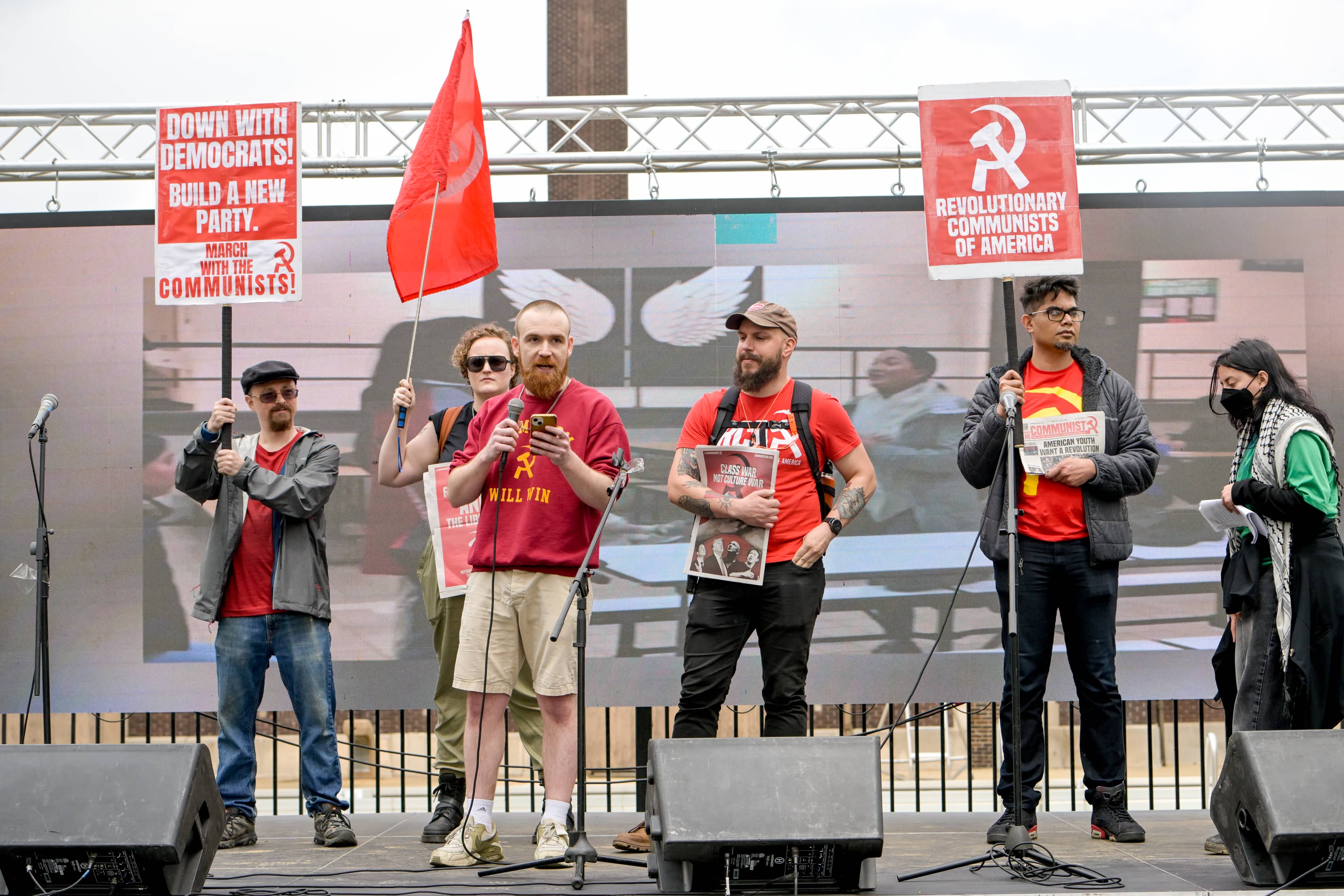
Chicago’s socialists and establishment Democrats are turning on each other. The question is whether anyone else can benefit
It’s hard not to notice that the Democratic Party is at war with itself. For years, establishment Democrats prided themselves on having a “big tent” capable of accommodating everyone from moderate labor Democrats to activists on the far left. In retrospect, that may have been a mistake.
The Democratic Socialists of America did not enter the Democratic Party because they admired it or wished to preserve it. They entered because they understood they could never build a viable socialist party of their own. The Democrats offered ballot access, campaign infrastructure, fundraising networks, and a ready-made voter base. Having gained entry, they proceeded to push the party steadily leftward, often against the instincts of ordinary Democrat voters. Now, many establishment Democrats are discovering the activists they spent years appeasing have become rivals for control of the party itself.
The latest chapter in this struggle is unfolding in the race to replace Congressman Jesús “Chuy” García. Readers will recall García announced at the last possible moment he would not seek reelection, clearing the way for his former chief of staff, Patty García — no relation — to secure the Democratic nomination. Critics across the political spectrum condemned the maneuver as insider politics at its worst, arguing voters were effectively denied a meaningful opportunity to choose among competing Democratic candidates. Because Patty García entered through the Democratic primary process, she needed only 697 signatures to secure a place on the ballot.
Independent candidates faced a dramatically higher hurdle. Former Planned Parenthood executive Mayra Macías and 25th Ward Alderman Byron Sigcho-Lopez (aka BS Lopez) both chose to enter the race as independents after the primary. To do so, they were required to collect 10,816 valid signatures, more than 15 times the number required of the Democratic nominee. Both campaigns submitted well above that threshold, but allies of Patty García subsequently filed objections challenging hundreds of signatures. As a result, both candidates have spent weeks fighting for ballot access instead of discussing policy or campaigning among voters.
According to reporting by the Chicago Tribune, the challenge process has become a costly and time-consuming ordeal. Macías told the newspaper her campaign has spent tens of thousands of dollars dispatching staff members and notaries throughout the district to locate petition signers and secure affidavits confirming that the signatures are legitimate. “The biggest frustration that I have with this process,” she said, “is that we’re so focused on the process of getting on the ballot that we don’t have time to talk policy, that we don’t have time to focus on substantive issues.”
BS Lopez has been even less optimistic, publicly acknowledging his campaign may not have gathered enough evidence to survive the challenge. He described the deadlines imposed by election authorities as unreasonable and argued the standards appeared to change throughout the process.
What makes this dispute particularly revealing is that both sides are accusing the other of undermining democracy. Macías has accused Patty García’s supporters of weaponizing ballot-access laws to eliminate competition. BSL has compared the challenges against his petitions to efforts by Republicans to manipulate election rules. In other words, establishment Democrats and Democratic Socialists are now accusing one another of exactly the sort of anti-democratic conduct they routinely denounce when practiced by their political opponents. The result is a remarkable spectacle: rival factions of the same party battling one another over access to the ballot while claiming to be defending democracy.
The broader significance of the fight extends well beyond a single congressional race. Chicago now has approximately 20 DSA-affiliated members on the City Council, giving the organization influence far beyond what its numbers might otherwise suggest; after all, DSA only has a pathetic 2,700 members out of the over 1 million registered voters.
Let that sink in, as the saying goes: Less than one percent of the electorate controls 40 percent of the City Council! Talk about disproportionate impact!
Many of these officials promote policies that strike ordinary voters as ideological experiments rather than practical solutions. Whether the issue is policing, criminal justice, public safety, taxation, or economic development, the DSA faction frequently places activist priorities ahead of the everyday concerns of residents who simply want their neighborhoods to be safe and their city government to function effectively.
Mayor Brandon Johnson is not formally a member of the Democratic Socialists of America, but many voters struggle to identify meaningful differences between his agenda and theirs. His administration has consistently aligned itself with the priorities of the Chicago Teachers Union (CTU) and the activist left. Whether that reflects personal conviction or political necessity is almost beside the point. The practical effect has been to reinforce the perception that City Hall is governed more by ideological constituencies than by a commitment to competent municipal management. To many Chicagoans, Johnson appears to be DSA in everything but official party membership.
What makes this moment politically important is that even prominent Democrats are beginning to acknowledge the problem. Veteran strategist James Carville has openly argued Democrats need a clearer separation from the activist left if they hope to rebuild credibility with working-class voters. That is a remarkable admission from one of the party’s most experienced political operators. It suggests at least some Democrats have recognized the forces they spent years accommodating are now threatening the party’s future.
For those of us who consider ourselves Contrarians, the lesson is not to jump into the middle of this fight. Quite the opposite. As Napoleon reportedly observed, when your enemy is making a mistake, don’t interrupt him. The Democratic establishment and the Democratic Socialists are increasingly at war with one another. They are spending time, money, and political capital fighting internal battles instead of governing. There is no reason for sensible voters to get in their way.
Instead, we should be looking for opportunities. Chicago remains a heavily Democratic city, and it is likely to remain one for the foreseeable future. That means the path to better government is not necessarily through ideological purity or partisan wishful thinking. It may require supporting candidates who are not perfect but who are willing to put competency ahead of ideology, public safety ahead of slogans, and taxpayers ahead of special interests.
Most Chicagoans are not Democratic Socialists. Most are not hard-core conservatives either. They occupy the broad sensible center that exists between the political extremes. They want safe streets, functioning schools, reliable public transportation, clean neighborhoods, and city finances that don’t require a new tax increase every six months. They want a city government that focuses on doing its job rather than lecturing them about political theories.
If the growing schism within the Democratic Party creates opportunities for candidates who share those priorities, Contrarians should be prepared to seize them. Sometimes progress comes not from defeating an opponent outright, but from taking advantage of the openings created when that opponent begins fighting with itself. The socialists and the Democratic establishment have spent years marching in the same direction. Now they are increasingly marching against each other. That may be the best opportunity advocates of common-sense government have seen in years.
Whether that opportunity ultimately produces new leaders, a new coalition, or simply better choices for voters remains to be seen. But one thing is certain: Chicago did not become a great city through ideological extremism. It became a great city because generations of leaders focused on the basic responsibilities of government and understood that competence matters. If this Democratic civil war helps move the city back toward that principle, it may end up doing Chicago some good after all.
