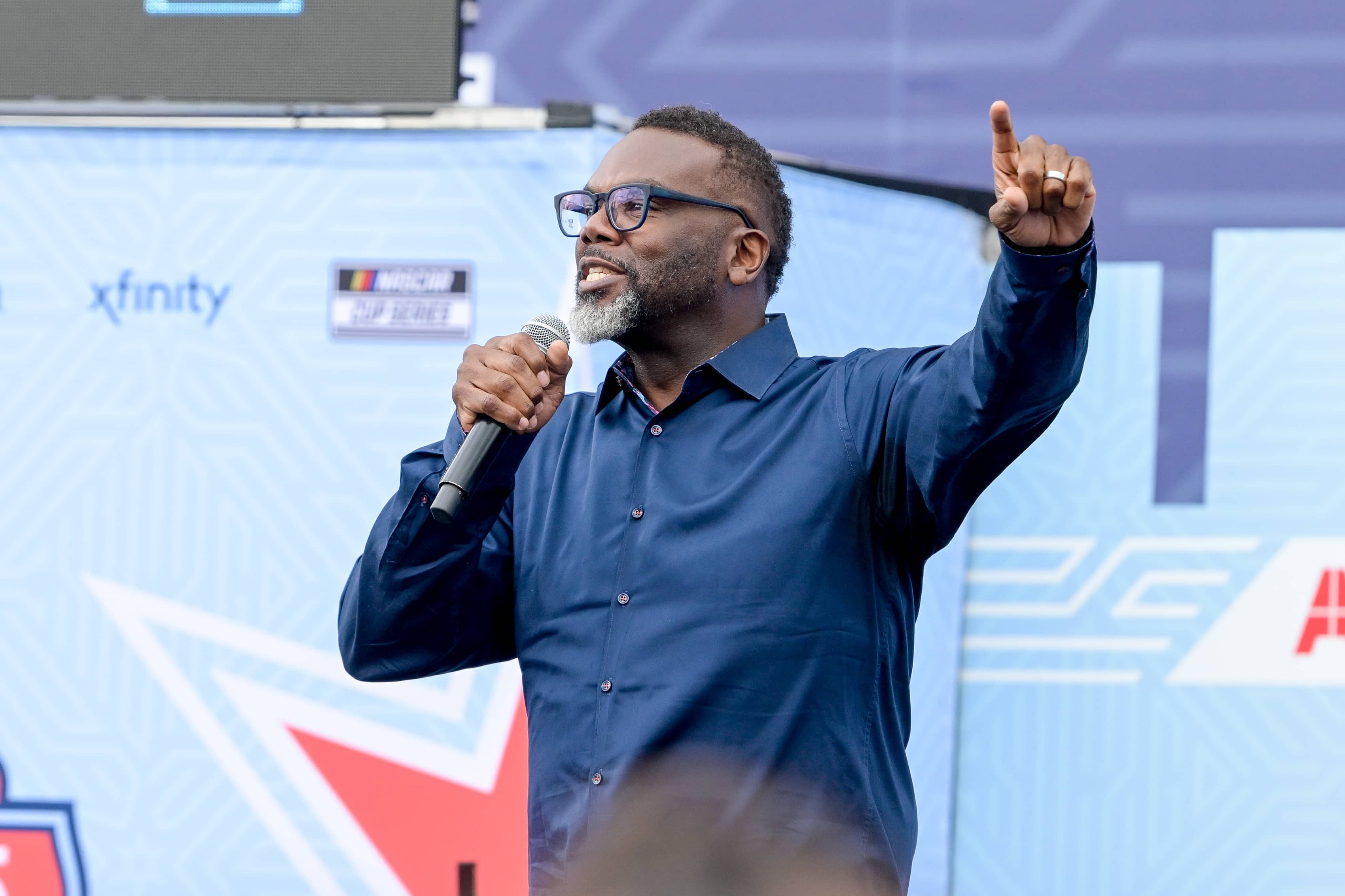
When faced with a question he dislikes, Mayor Brandon Johnson screams racism
It’s the oldest magic trick in the book. The magician spreads out a deck of cards and says, “Pick a card. Any card.” You choose one, hide it from him, and he puts his fingers to his temple like a psychic and dramatically says: “I’m getting something…the King of Spades.” You look at your card and exclaim, “My God, that’s incredible!” Then, if he wanted to reveal the trick and show you that the joke’s on you, he’d fan out the deck so you see every single card is the King of Spades. There’s no mystery. There’s no psychic ability. The deck was fixed.
That routine came immediately to mind when I watched Mayor Brandon Johnson’s latest exchange with reporter William Kelly, who asked a tough but entirely legitimate question about policing. Johnson didn’t answer it. He didn’t explain his policies. He didn’t defend his record. Instead, he reached for the same card he always seems to pull from the deck.
“Though you are accusing me of being anti-police,” Johnson replied, “your behavior is anti-black.”
There it was again. The King of Spades. The race card.
Chicago Contrarian’s rapid response team captured it perfectly on X:
“This is vintage Brandon Johnson. He doesn’t like the reporter or the question, so he reaches for the Left’s weapon of choice—the reckless and baseless accusation of racism. Johnson is an absolute disgrace.”
Whether you, I, or Mayor 6.6 happen to like Kelly’s style or any other reporter’s style is beside the point. The press has a constitutional right — and obligation — to ask uncomfortable questions. Public officials aren’t entitled to softball interviews regardless of race, color, creed, etc. Their job is to answer difficult questions honestly and directly. That’s how a free republic is supposed to work.
Unfortunately, Mayor, 6.6 appears incapable of doing that. Every disagreement becomes evidence of racism. Every criticism becomes an attack on his identity. Every difficult question is transformed into a morality play in which he is the victim, and the questioner is the villain. It’s a remarkably disingenuous strategy that allows him to avoid discussing the substance of the issue altogether.
Chicagoans deserve better than that. They deserve answers about why the Chicago Police Department remains thousands of officers below authorized strength. They deserve answers about why detective promotions have lagged so badly. They deserve answers about teen takeovers (“teen trends” in euphemistic Brandonspeak), repeat violent offenders, clearance rates, and why so many residents no longer feel safe in neighborhoods that once were. Instead, they’re treated to another lecture about identity politics whenever somebody asks a question the mayor doesn’t like.
That doesn’t help the families on the South and West Sides who live with violence every day. Those communities aren’t suffering because reporters ask difficult questions. They’re suffering because a tiny fraction of the population commits a wildly disproportionate share of violent crime. City Hall seems more concerned about ideological talking points than holding habitual offenders accountable.
Years ago, law enforcement maintained a gang database to help identify the most dangerous repeat offenders. They had ShotSpotter for a timely response to shootings that could catch perpetrators and save the lives of victims instead of leaving them to bleed to death on the streets alone, afraid, and untreated. Those tools disappeared in the name of avoiding “adverse impact” — two words that have become an excuse for abandoning common sense in favor of ideological purity.
If you want to talk about adverse impact, let’s ask Mayor 6.6 how he feels about the fact 95 percent of murder victims in this town are “of color.” Those folks aren’t buying his little magic trick with the stacked deck. They know better. They support the police. They want more police in their neighborhoods to protect them from the predators that prey upon them every single day — 24 hours a day, seven days a week, 365 days a year for the last three years of his miserable failure of a mayoral reign.
Meanwhile, the victims continue to pile up. Stray bullets cut down children. Innocent people are caught in gang crossfire. Yet we’re told the answer is another violence interrupter, another midnight basketball program, another YMCA membership, another taxpayer-funded initiative that never seems to interrupt much violence. Social workers have an important role in society, but they are not SWAT officers, and sociology classes don’t teach room-clearing tactics. Sending unarmed civilians into situations that require armed police isn’t compassion; it’s recklessness.
The irony in all of this is impossible to ignore. Brandon Johnson has repeatedly criticized policing while surrounding himself with the largest security details in city history -- reportedly 150 sworn officers strong — officers who should be on the streets, on their beats, protecting his beleaguered constituents. If police protection is so unnecessary, ineffective, and even counterproductive, why does the mayor travel everywhere with this massive Praetorian Guard, like Nero watching his city burn?
If officers are indispensable when protecting City Hall, why are they somehow superfluous when it comes to protecting the neighborhoods where ordinary Chicagoans live?
Now the city enters another long, hot summer without a permanent police superintendent. Larry Snelling is gone, perhaps because he had enough of Mayor 6.6 and his risible tricks, and nobody knows who will replace him. Will it be a respected veteran of the Chicago Police Department who understands the city, its neighborhoods, and its unique challenges, who commands the respect of the thin blue line? Or will it be another politically fashionable appointment — maybe from out of town — with no experience on the mean streets of the Chi — designed to satisfy ideological and identity politics rather than restore confidence in and within the third-largest police department in America? We don’t know, and that’s a disturbing position for Chicagoans to be in.
Johnson’s defenders insist he supports Chicago Police. Fine. Then answer the question. Explain the repeated statements criticizing policing. Explain the staffing shortages. Explain the broken promises to increase detective ranks. Explain why officers continue leaving faster than they’re being replaced. Explain why crime remains the defining issue of his administration. That’s what reporters are asking. Those are fair questions. Accusing the questioner of racism isn’t an answer. It’s a cheap dodge. Chicago's cops and citizens deserve better.
Great politicians have always understood this. John F. Kennedy could defuse a hostile question with humor. Ronald Reagan did it with charm. This poor excuse for a mayor has no sense of humor, no charm, no grace under pressure. Have you ever seen him smile? Even politicians I disagreed with usually understood that democracy requires answering the press rather than attacking it. Mayor 6.6 seems incapable of making that distinction. His skin is paper-thin, but his head is remarkably thick. Every press conference feels less like an exchange of ideas and more like another exercise in identity politics.
Recent polling suggests only 14 percent of Chicago voters want Brandon Johnson to even seek another term, much less be willing to vote for him. Donors are finding his opponents, not him. That shouldn’t surprise anyone. Chicagoans are tired of excuses. They’re tired of slogans. They’re tired of hearing that every criticism is somehow rooted in prejudice instead of frustration with the city’s direction. Working people — the very people Johnson claims to represent — aren’t asking for another lecture. They’re asking for competent government.
If the mayor wants to change those numbers, the solution is remarkably simple: Stop pulling the same card out of the deck every time someone asks a difficult question. Start answering the question instead, and make the tough choices that make it easy to answer the tough questions, because eventually the audience figures out the trick. The magician isn’t reading minds. He’s playing with a stacked deck, and the race card isn’t a cool hand anymore.
