
The education of Chicago’s children is at stake, and so is the city’s future political power structure
Of the many races in the November 3rd election in Chicago, none is more important or the most contentious than the one at the very bottom of the ballot: The election for Chicago’s first fully elected school board and an end to mayoral control of the public schools. This pivotal moment will determine not only the academic and financial direction of the Chicago Public Schools and their 304,687 children, it will also set the course for who will ultimately wield power in the City of Chicago.
Depending on the outcome, the impact will extend beyond the interests of children and schools. Chicago’s politics and power structure will go through a radical shift that may persist for generations. Make no mistake, this election is the precursor to the February mayoral election. Yet most voters aren’t even aware these races are taking place, let alone understand the ramifications of their results.
Chicago’s schools have historically been at the center of power. The power brokers of the old machine utilized schools as an access point to voters and, in some instances, served as patronage hubs. PTAs, fathers’ clubs and local school councils were often connected to local aldermen as a means to reach parents and influence voter turnout. Seems quaint by today’s standards of school politics.
The political interests that govern the Chicago Public Schools today have a different agenda. They seek not only to maintain control over the schools as a power base, but also intend to indoctrinate students with an extreme leftist political dogma. Their ideology aligns with their socialist agenda, which they aim to promote directly from the schoolhouse to the fifth floor of City Hall, is foisted onto our communities, and is financed by you, the taxpayers of Chicago. Just check your upcoming property tax bill.
This is not hyperbole. It is the reality of Chicago’s political landscape.
The primary protagonist in this narrative is, of course, the Chicago Teachers Union (CTU). The CTU has long been a significant force in Chicago politics, but its current agenda, or “social justice unionism” as they call it, extends far beyond the needs of its rank-and-file members. Under the leadership of President Stacy Davis Gates and Vice President Jackson Potter, a radicalized version of the CTU has openly pushed its socialist leanings, aiming to remake Chicago’s political landscape and align the city’s policies with its interests. For them, the education of children is incidental. It’s a means to their end: Building power.
However, this has not always been the case.
Since 1995, when the Illinois General Assembly (IGA) gave then-Mayor Richard M. Daley full control of Chicago Public Schools, each mayor since has had the challenge or opportunity of managing the behemoth that is CPS. What was once criticized as the “worst school system in the nation” by U.S. Secretary of Education William Bennett in the late 1980s was then hailed as the model of school reform by President Bill Clinton following the remarkable educational transformation of the 1990s.
During the early years of Daley’s tenure, the Chicago schools experienced a period of unprecedented success. This era was characterized by balanced budgets, labor peace, academic accountability, educational reforms and innovation, and greater school options for parents and kids.
However, after 15 years of accountability, the Chicago Teachers Union had a fundamentally different perspective. In 2010, a new caucus, CORE, Caucus Of Rank-and-file Educators, took over the union and launched a strategic campaign to exert greater influence, not only over the schools but over the city of Chicago. In pursuit of their leftist agenda, the newly radicalized CTU made clear its intention to take a more assertive and extreme approach. Holding schools and educators responsible for the education of children was not in the plan.
Rahm Emanuel came into office denouncing what he described as a system where the adults got taken care of and “the children got the shaft.” He was right and quickly found a worthy adversary in the CTU and its newly elected president, Karen Lewis.
“It seemed like Rahm wanted to just ham-fist everything,” wrote Lewis in her posthumous book, I Didn’t Come Here to Lie: My Life and Education. “He wanted a longer school day, and he campaigned on it. He also named Juan Rangel as co-chair of his campaign. Rangel was CEO of the United Neighborhood Organization charter school network, and we were fighting privatization. So Rahm making Rangel a key adviser was another signal that an all-out attack on the CTU was about to be launched.”
Oh, well.
In 2012, Lewis and the CTU orchestrated the longest school strike since 1987, emerging victorious and determined to leverage its power as a weapon to gain the upper hand over Mayor Emanuel. Despite legislative efforts to limit their influence, the CTU understood the basic principle of power: use it or lose it. They used it, and they won. Karen Lewis was on her way to challenging Rahm Emanuel for Mayor in the next election.
As fate would have it, Lewis was sidelined when she was diagnosed with a brain tumor. Before her passing, Lewis hand-picked Jesus “Chuy” Garcia to be the CTU’s foil against Emanuel in the 2015 race for Mayor. Chuy came up short in that election and so did the CTU. Lesson learned.
After Lewis, CTU’s leadership became even more aggressive, and more overt in promoting a socialist agenda, while hiding behind a less inflammatory moniker, “Bargaining for the Common Good.” This allowed the CTU to pursue issues beyond schooling, specifically, in Jackson Potter’s words: “How the labor movement needs to call for what was previously considered outside the domain of traditional models of collective bargaining.” Potter made his case in an In These Times opinion piece titled “The Strike That Started the Red Wave.”
In 2019, the CTU tried once again to take City Hall, this time backing Cook County Board President Toni Preckwinkle, to no avail. The prize went to Lori Lightfoot, who proved unable to maintain control of the schools or the city for that matter. Lightfoot tangled with the CTU but she proved to be no match for them and acquiesced to their every demand, allowing CTU to strike several times without a real confrontation and ultimately rewarding the union with substantial pay increases. In the process, CPS agreed to neutralize the CTU’s competition from charter schools, as the power once emanating from City Hall’s 5th floor rapidly disintegrated.
The CTU also subscribes to another political adage: “Power is not given; it is taken.” Having lost twice at the ballot box, and facing a weak mayor, the CTU set out to change the rules. It demanded legislation to establish the first elected school board, one it believed it could win, despite their previous loss in mayoral contests. The IGA gave in to the powerful union and passed the elected school board law. Electing its own school board would give the CTU ultimate control of the institution from which it derives its power.
The CTU took Saul Alinsky’s model of organizing people and money to build power and merged it with a newfound patronage system: Teachers’ dues elect politicians who will bow to the union, while its most radical members and its paid nonprofit allies form a formidable ground game. What a novel idea.
The CTU’s return-to-patronage formula for building power had eluded most of Chicago’s political factions since the Daley years. The CTU became the dominant force in Chicago.
In 2023, the CTU made another run for mayor, this time with one of its own: CTU organizer Brandon Johnson as their candidate. Johnson was a long shot, but the CTU was determined to assert itself as a political powerhouse that would have to be dealt with one way or another. In an unexpected turn of events, Johnson won the election, and all bets were off. As they say, to the victor go the spoils, and the CTU never looked back.
However, under the CTU’s reign, Chicago’s schools have once again descended into a dire state: Only 27 percent of students are proficient in math and only 47 percent read at grade level. Recent enrollment figures reveal that the Chicago Public Schools (CPS) continues its steep population decline, with 11,573 fewer students today compared to the previous academic year. Since CORE’s rise in 2010, CPS has lost approximately 100,000 students, falling from 404,000 to 304,687 in the 2026-27 school year.
The CTU continues to repeat its popular slogan to “fully fund” schools, suggesting that a lack of money is the primary obstacle to student success. Yet despite the enrollment loss, CPS keeps increasing its budget and spending. During and after the COVID-19 pandemic, the budget swelled from $7.7 billion to more than $9 billion. CPS and the CTU show no interest in curbing their appetite for more money and more staff. It’s their power base, after all.
With a budget of more than $10 billion and far fewer students, CPS now spends more than $32,000 per student in total. Each year, the district levies the maximum property tax allowed by law, and more than half of the typical Chicago property tax bill goes to finance CPS’ overspending.
Since CORE seized control over the union in 2010, and especially since 2023, CPS has shown a reckless disregard for its responsibilities, operating as a bureaucratic juggernaut with an unlimited credit card. The CTU has been either complicit in or actively driving this mismanagement.
Regrettably, the children are still being cheated. Only now the agenda is even more overt in the CTU’s vicious grab for power and money, aided and abetted by its hand-picked mayor. Yet Johnson is a side character in this drama. He does the bidding of Stacy Davis Gates, who lords over Chicago like a true political boss. Her actions and the CTU’s have further politicized the public schools, deprived children of learning, and are ultimately destroying a once-great city.
In the post-Daley patronage era, the CTU has emerged as Chicago’s dominant power broker, and it is resolute in keeping that position, not only in the schools but in the city as a whole. Pursuing its agenda, as Potter wrote: “Will largely depend on having a progressive city government in Chicago.” And in 2025, Davis Gates expanded her power base statewide when she was elected president of the Illinois Federation of Teachers. Expect her and her allies to export their brand of politics to a suburban or downstate school district near you, very soon.
There is, however, a bright spot: People power. Earlier this year, the CTU pressed CPS to let all students and staff take part in its May 1st ‘Day of Civic Action” political rally. Initially, CPS CEO Macquline King went along, agreeing to close schools and send public school children to an unprecedented joint CPS/CTU political protest. CPS even offered buses to the rally at Union Park. The decision disregarded children’s safety and gave up another day of instruction for political purposes. It would have been one more day of indoctrination, the new norm under the CTU, until public school parents organized and threatened legal action against CPS. CPS and King quickly retreated, much to the chagrin of Stacy Davis Gates.
Rank-and-file teachers also spurned Davis Gates’s request to raise member dues to pay for politics in the school board races and for Brandon Johnson’s re-election. They rejected it overwhelmingly.
Public school parents and rank-and-file teachers have begun to assert their own power. The time has come for voters and taxpayers to do likewise.
All of this brings us to November 3rd. In the first fully elected school board races, Chicagoans will have a chance to take back their schools from the CTU’s power elite and clip its wings. If the CTU wins the board in November and keeps the mayor’s office in February, it will sit on both sides of the bargaining table, and its consolidation of power will be complete. No sugar-coating here: Voters have a clear choice. They can vote for the CTU’s extreme politics, which use children as human shields in its drive for power, advance its socialist agenda, and bankrupt the school system while demanding more, all on the taxpayers’ dime. Or they can choose a more aspirational vision that returns the schools to parents and communities and lets children be children, not an indoctrinated CTU youth brigade marching to the union’s drum toward a bleak future.
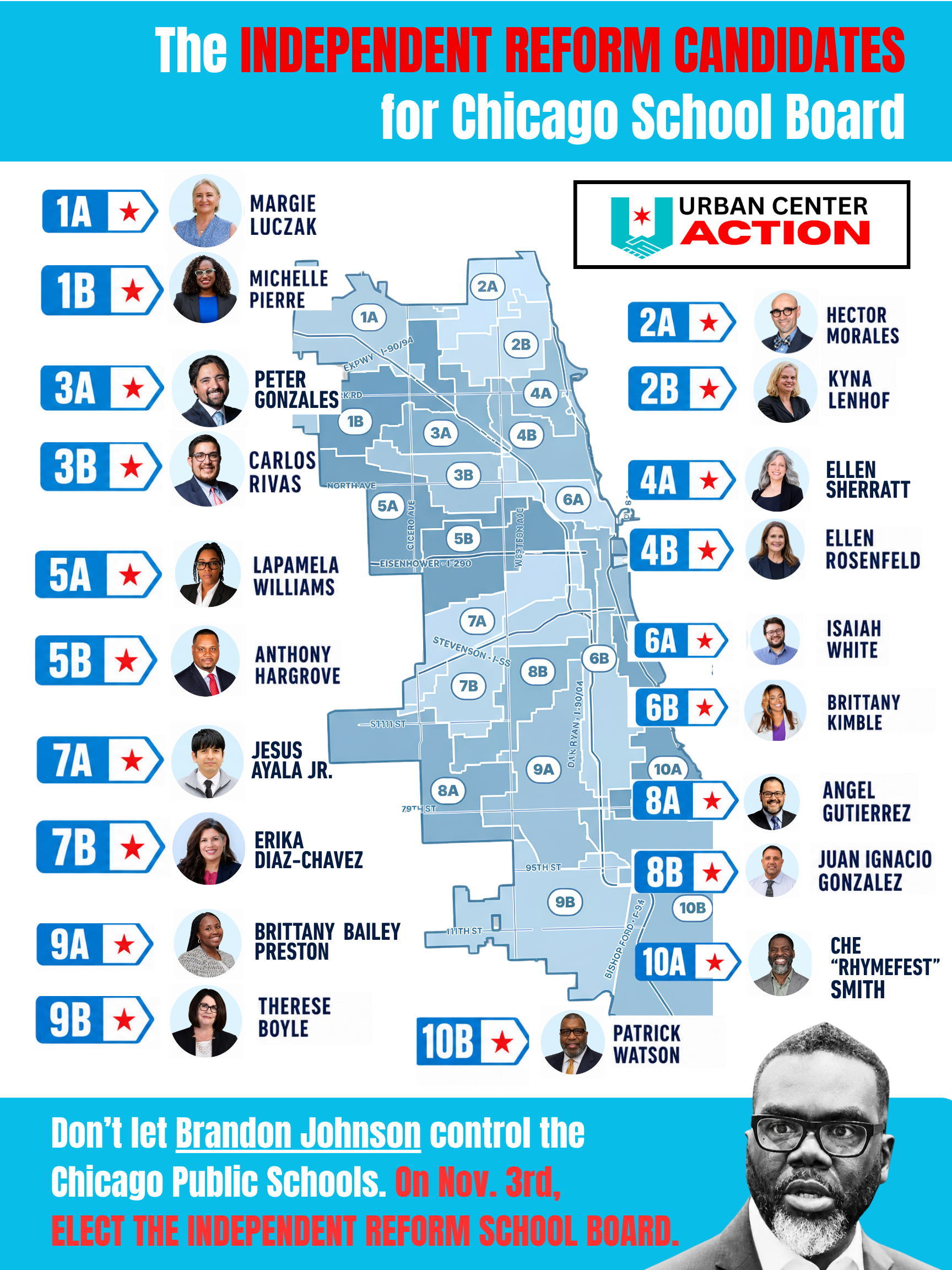
A new, independent, reform-minded board can rein in reckless spending at CPS and demand academic accountability on behalf of kids and parents. Our partners at Urban Center Action have endorsed the candidates in the graphic above over the CTU’s candidates. They are your neighbors, who have taken up the call for real reform and accountability and are committed to breaking the CTU’s and Brandon Johnson’s political grip on our schools. Not surprisingly, the CTU and its allies have targeted them with harsh rhetoric, but they are ready to take on the CTU. Change does not happen in a vacuum. It is organized.
At The Urban Center, our battle cry is “Take back our city!” That begins with our grassroots army of community leaders, now candidates, who are willing to push back on the powers that be. Twenty school board races now have a candidate challenging the CTU. We are proud that The Urban Center identified 14 of those candidates early on, and that 10 are graduates of our MLI Next Gen leadership institute. You can’t have a contested election without candidates.
That’s not a coincidence; that’s our strategy at work. The CTU will not be given a pass. Now we need to win!
On November 3rd, we urge you to do your part to elect an independent, reform-minded Board of Education. The next battle comes in February, when we help elect a new mayor of Chicago. Join us.
Juan Rangal is the founder, President and CEO of the Urban Center.
The Urban Center (www.theurbancenter.org) is a 501(c)(4) nonprofit organization whose mission is to organize and give voice to a centrist community through a ‘common sense’ agenda that builds strong families, safe neighborhoods and greater economic opportunities. Hear more on The Urban Center’s podcast, “Who Sent Ya? Chicago, Politics and More,” in our two-part episode “The Rise of the Extremes.”
