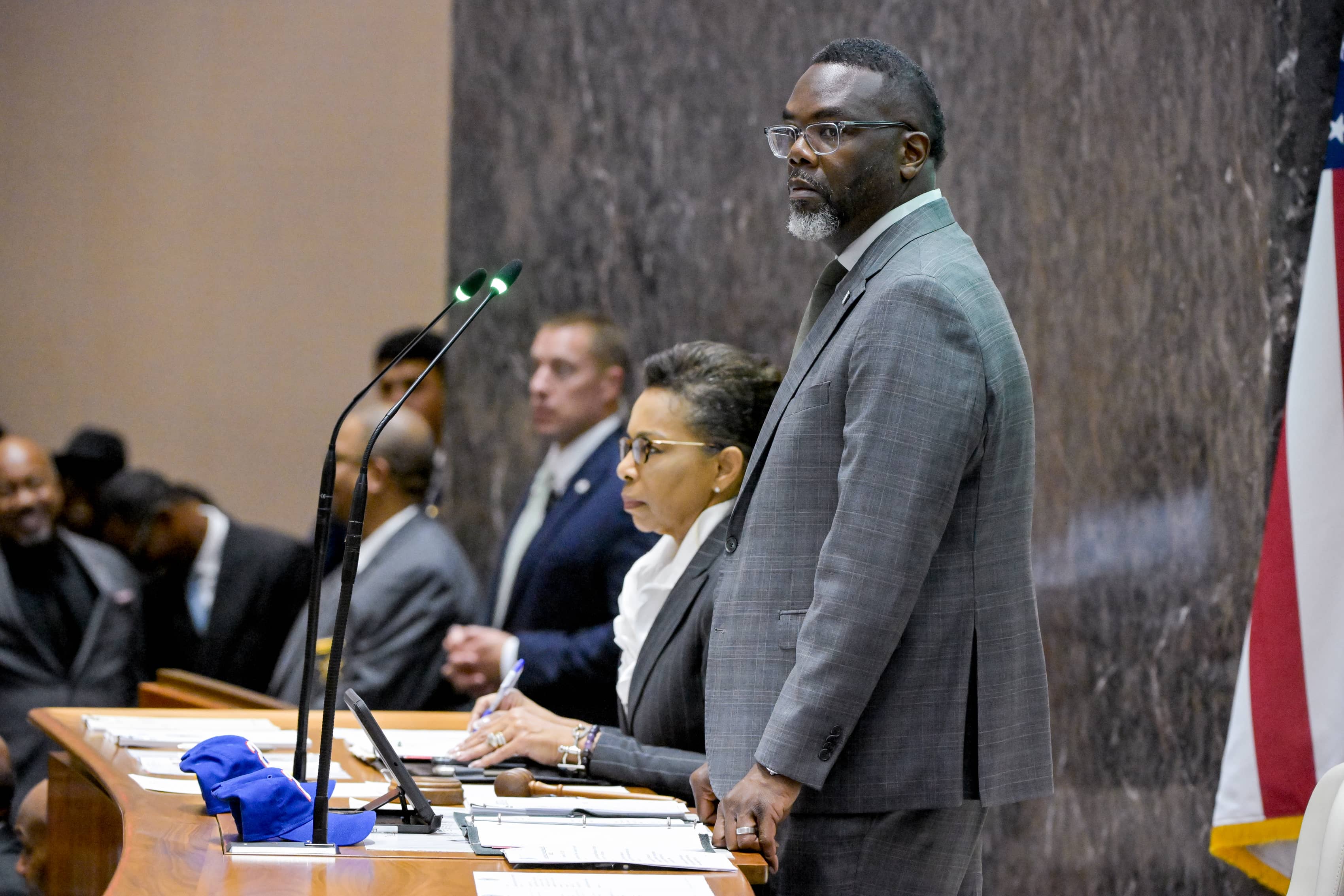
Mayor Johnson continues to dangle reparations in a cynical ploy to court Black voters
Confronting the enduring injustices and legacy of slavery is a serious, solemn undertaking. However, when race and racism are routinely invoked to explain away every problem, deflect every criticism, and justify every failure, the case for genuine reparations is diminished. Unfortunately, this is precisely the tack Mayor Brandon Johnson has followed to respond to nearly every crisis plaguing Chicago and affecting Black residents.
Johnson’s so-called “reparations” initiative is not a serious policy agenda. Rather, it is a political defense mechanism designed to rally his base, shield him from criticism, and distract from the growing discontent within the very communities that feel left behind by his administration’s decisions, especially his migrant policies. Johnson earmarked $500,000 to launch the “Repair Chicago” process, which is being framed as a forum to collect “lived experiences of harm” rather than as a program with concrete remedies.
Johnson’s “Repair Chicago” is not reparations in any meaningful sense. Far from a solution, it is a diversion, an attempt to repackage grievance while sidestepping responsibility for the tangible damage Johnson’s administration — and that of his longtime ally, the Chicago Teachers Union — has inflicted on the Black community today.
Historical amnesia and moral evasion
Reparations, in principle, involve compensating living individuals for harms inflicted upon their ancestors — wrongs committed by people long deceased, paid for by those who did not commit them. Illinois was a free state, and more than 250,000 men, almost all White volunteers, fought for the Union in the Civil War; roughly 35,000 died in the struggle to end slavery. Those facts do not erase the history of slavery, but they do complicate simplistic narratives of collective guilt and collective debt.
Today, Chicago is a diverse city, and many residents descend from immigrant families which arrived long after the Civil War. My own grandparents were Greek immigrants, descendants of a people who withstood over 400 years under oppressive Ottoman rule. That history, too, matters when political leaders try to reduce civic life to inherited guilt and permanent grievance.
Yet Johnson and his allies need a distraction from their record. The Black community — ostensibly the intended beneficiary of his reparations initiative — is the same community that has disproportionately suffered from his failures to ensure safety, quality education, and economic opportunity.
Crime and disorder
Johnson has repeatedly excused or minimized crime. When teen mobs overtook downtown streets in the summer of 2023, he brushed it off as “kids being silly,” while condemning critics for referring to them as “baby Al Capones.” That instinct to frame every breakdown of order as evidence of systemic racism, rather than civic failure, has left many Black neighborhoods feeling unprotected and abandoned.
Chicago still struggles with violent crime, and recent reporting shows that high-priority 911 calls often go unanswered. In 2024, nearly half of all 127,000 of high-priority calls had no police available for immediate response, a 50 percent nonresponse rate. In 2023, the rate was 52 percent, compared with one percent in 2019.
Johnson also dismantled tools that were proven to save lives. He canceled the ShotSpotter gunshot detection program, denouncing it as racist, even though the city kept it in place during the 2024 Democratic National Convention. Chicago Police had credited the technology with helping save lives, and the loss of that tool only deepened the city’s response gap.
Undermining educational opportunity
Nowhere is the damage more enduring than in K-12 education. Long before his mayoral run, Johnson, a former Chicago Teachers Union activist, made clear that he was hostile to the structure of public education as it is commonly understood. He criticized homework, standardized testing, academic accountability, and school choice itself.
Johnson’s education supports a de facto Apartheid education system in Chicago in poor children, overwhelmingly Black and Latino are subjected to the racism of low expectations and no accountability. It’s a system that rejects standards, demonizes testing, and celebrates graduation rates that are not tied to real achievement. It views accountability as oppression. For poor families, accountability is not oppression. It is necessary to achieve equity.
Meanwhile, many educators who defend the current system choose something different for their own children. Nearly one-third of Chicago public school teachers send at least one child to private school, a telling sign of how deeply confidence in Chicago Public Schools has eroded while an equal number find a way to get their children into the city’s public magnet schools.
As mayor, Johnson’s appointed Board of Education passed a resolution calling for a transition away from privatization and selective enrollment programs, using language that effectively targets charter and magnet schools — often the only alternatives to failing neighborhood schools for thousands of low-income Black families.
Chicago’s charter sector serves more than 54,000 students, and the students are overwhelmingly Black or Latino and low-income. Selective-enrollment schools, meanwhile, remain among the strongest pathways to social mobility for minority students who can gain admission. These are not examples of inequity; they are examples of opportunity.
Economic “equity” that hurts small businesses
Johnson’s economic policies have also failed the communities he claims he seeks to uplift. He has pushed a series of tax-heavy, business-discouraging measures, including higher mandates on private employers and wage rules that hit small minority-owned businesses especially hard. Chicago’s 2025 budget brought more than $532 million in new taxes and fees, most of them regressive and likely the majority falling on businesses.
Johnson has also shown no hesitation allowing his controlled school board to raise property taxes to the levy limit, generating over $500 million in new revenue. This increase combined with the shift in property tax burden from commercial to residential property has nearly doubled property taxes in some of Chicago’s poorest Black and Latino communities by as much as 75 percent.
Prioritizing migrants over residents
Perhaps the mayor’s starkest political betrayal concerns his migrant policies. To sustain Chicago’s sanctuary-city posture, Johnson has devoted enormous city resources to migrant housing, health care, and legal services, while state spending on migrant care has also climbed into the billions. Illinois was projected to spend about $2.5 billion on migrant care by the end of 2025, with most of it tied to health care and related support services.
The Chicago public schooling system has also borne major costs associated with new migrant students, even as the district struggles to serve its existing population. At the same time, Johnson’s other signature programs have been modest to tiny in scope: “Treatment Not Trauma” supports only a handful of mental health centers, the environmental department expansion has been small, and youth job opportunities have barely returned to pre-COVID levels and remain limited to the summer.
The result is tragically clear: While Sanctuary City policies have attracted a huge influx of illegal migrants, the nation leading exodus of Black residents continues. The data reveal this displacement: Since 2000, the city has lost more than 250,000 Black residents — mostly middle‑income families. The adult Black population has declined 14 percent, while the number of Black children has dropped by nearly 50 percent. Black enrollment in Chicago Public Schools is now less than half of what it was in 1999–2000.
The real path to equity
Make no mistake: The ideology and policies of Mayor Johnson, the CTU leadership, and their socialist allies will make matters worse, not better. The mayor cloaks failure in moral language, using the rhetoric of race as a political shield. When confronted with policy collapse, he too often turns to racial grievance instead of results. Worse, Johnson uses divisive rhetoric in his speeches about reparations castigating city residents and their families who played no part in slavery or the harm committed.
True racial justice cannot be achieved through symbolic politics or selective outrage. Equity demands fundamentals: Safe neighborhoods, strong families, rigorous schools with real accountability, accessible transit, and genuine private-sector opportunity. It means fostering ownership — of homes, businesses, and futures — so that wealth and stability can become generational.
Chicago does not need more commissions or slogans. It needs leadership willing to confront reality rather than weaponize it. Mayor Johnson may find political comfort in turning every setback into a racial grievance, but the people of Chicago — especially its Black community — deserve policies grounded in results, not rhetoric.
