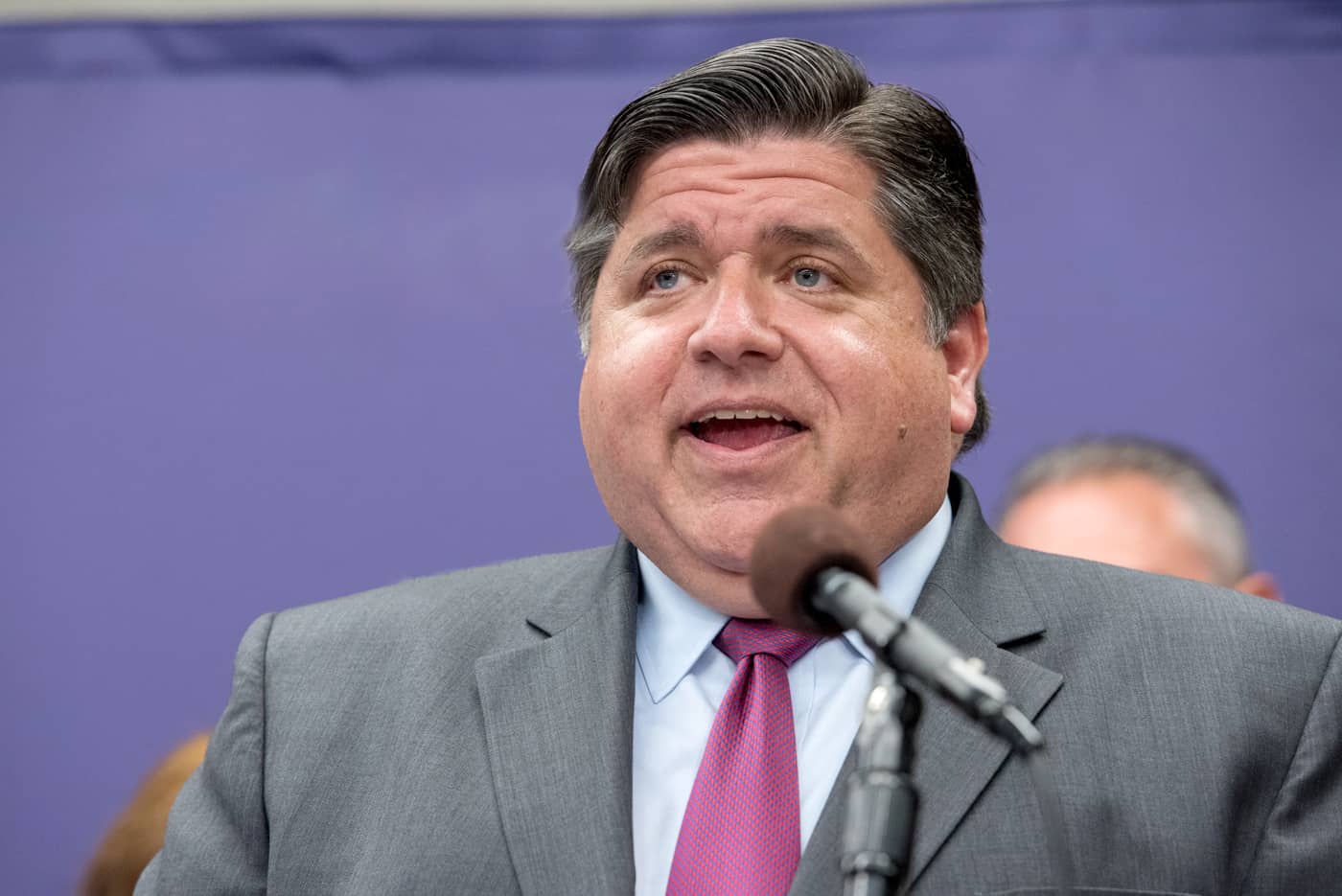
Pritzker's failure during COVID still hangs over his two terms in office
As Anthony Fauci appeared before Congress this week, invoking his Fifth Amendment right against self-incrimination more than 100 times, I could not help but recall the accolades showered on Fauci here in Illinois, including a 2024 award honoring his “highest standards of public service.” Just weeks before Fauci testified, Governor JB Pritzker was congratulating himself on his COVID response — among the very worst in the nation by empirical measures — frighteningly bragging about how prepared Illinois is for the next pandemic and how the state is “leading with science.”
Pritzker publicly tied much of Illinois’ pandemic governance to Fauci, regularly and forcefully endorsing Fauci’s pronouncements in his daily COVID briefings and elsewhere. In September 2020, for example, Pritzker said he “would not hesitate to follow the advice of Dr. Anthony Fauci” whenever case surges required action. Fauci was a “very reliable source of information,” Pritzker also said. “I rely on the guidance I hear from him.”
I had a personal encounter with Pritzker during my campaign for mayor, when I was finally granted an audience. Pritzker, who brought along his personal staff, spent the hour not talking about the multiple crises facing the city but peppering me with criticisms of my comments about his destructive COVID lockdowns — especially his science-defying closing of schools — made during my interviews with radio host Amy Jacobson, whose show he religiously tracked. This is the same governor whose office banned Jacobson from his daily COVID briefings in 2020 after she reported on his family’s travels, prompting a First Amendment lawsuit that forced her reinstatement. I, unlike Fauci, declined to take the Fifth.
Even in April 2022, well after Fauci’s credibility was broken by dissenting epidemiologists and other experts and Fauci himself had changed course on some matters, Pritzker was still clinging to Fauci’s authority, saying he “hoped and prayed” Fauci was right that the worst was behind us. Mark Glennon of Wirepoints does a masterful job documenting Pritzker’s failures and is unmatched in explaining his many COVID policy mistakes and their consequences.
The indictment of Pritzker’s management of the crisis isn’t rhetorical — it’s empirical. A National Bureau of Economic Research working paper gave Illinois an “F,” ranking it 46th of the 51 jurisdictions studied — sixth-worst in the nation — including 47th in economic performance and 43rd in keeping schools open. Illinois inflicted maximum economic and educational pain on its residents for a public health outcome that was, at best, average and, compared to less-restrictive states like Florida, arguably worse.
Pritzker issued 119 COVID-designated executive orders — the last in March 2023 — alongside 42 successive 30-day disaster proclamations, effectively allowing him to rule the state by fiat for 1,155 days: closing or restricting businesses and keeping school campuses shut many months after other states had fully reopened their public schools. The state’s emergency did not officially conclude until May 11, 2023 — longer than in 49 other states.
Pritzker’s COVID crisis management did permanent harm to the state’s economy and Illinois families, especially schoolchildren. Illinois kept most schools shut even when evidence turned against school closings: Barely 37 percent of Illinois schooling was in person in 2020-21, ranking 43rd in the nation, and Chicago’s high school students did not set foot in a classroom for 13 months.
Learning loss, developmental handicaps, and psychological trauma caused by school shutdowns are now widely regarded as catastrophic. Schoolchildren faced by far the lowest COVID risk of any age group, yet Illinois schools stayed closed long after even the CDC urged that schools should be “the last settings to close” and “the first to reopen.”
The unscientific COVID mitigations are matched by the mismanagement of COVID relief funds. Both the extended unemployment benefits managed by the state and a range of relief programs offered by the federal government are historic embarrassments. Pandemic unemployment insurance fraud is turning out to be what congressional investigators call the greatest theft of taxpayer dollars in American history — $100 billion to $135 billion nationally, by the Government Accountability Office’s estimate. Illinois’ own Auditor General found the state improperly paid out $5.24 billion in unemployment benefits, including $2.8 billion lost to identity thieves that will never be recovered.
It is frightening to think that Pritzker says he stands ready to do it all again. The absence of accountability begins and ends with Pritzker, who used a Fauci-style “trust the science” posture to impose draconian policies that took a brute-force approach directed at the entire Illinois population and economy, premised on misleading and often nonexistent data.
What made Illinois unique among the states during COVID was budget and finance policy that worsened the financial impact, seeming to contradict the intended purpose of federal COVID relief, which was to ease the financial pain of the mitigations. State and local taxing policies actually made the economic impact of the mitigations worse, as Illinois went on an unprecedented tax-and-fee rampage at the worst of times.
To be fair, the plethora of state tax and fee increases began in 2019, a year before COVID hit; however, there has been no letup. There have been at least 57 separate state tax and fee increases, costing taxpayers a cumulative $77 billion since Pritzker took office in January 2019, while local property taxes grew in Illinois by roughly 27 percent under Pritzker, climbing from $31.8 billion in 2018 to over $40.3 billion in 2024. These historic increases came despite the federal government providing Illinois some $54 billion in COVID support, including roughly $11.6 billion in direct, flexible relief for state government operations.
At a time when COVID mitigations were punishing businesses and imposing hardships on lower-income families, the state and local governments were compounding the hardship by increasing taxes and fees at an unprecedented level. Illinois residents pay the highest combined state and local tax rates in the nation, at more than 16.5% of a median household’s annual income. Illinois also carries some of the worst debt burdens in the country, with $15,804 in unfunded state and local public pension liabilities per person — the highest in the nation — and more than $218 billion in total unfunded liabilities across its 677 government pension plans.
Is it any surprise Illinois has suffered long-term economic underperformance? Illinois’ real GDP has grown 7.9 percent since early 2019, compared with 17.6 percent nationally, placing the state 46th among the 50 states. Illinois has seen virtually no private-sector job growth since 2019, and the state ended 2025 with 1,700 fewer jobs while the nation added 584,000. Illinois ended 2025 with nearly 302,000 unemployed residents, while labor-force participation fell to 63.8 percent by December.
Illinois revenue growth since 2000 has fallen far below inflation, reflecting not just the impact of COVID but also the overall weakness in the Illinois economy. Even counting all those tax and fee increases, inflation-adjusted general funds revenue has grown by an average of only $317 million a year — less than 1 percent annually. Illinois lawmakers found it necessary in last year’s budget to manufacture a total of $1.1 billion in one-time and recurring revenues because of paltry revenue growth, then followed this year with more than $800 million in new tax and fee increases.
Contrast Illinois’ post-COVID performance with states such as Florida and Texas, which quickly reopened their economies and their schools and used the federal COVID largesse to avoid tax increases and, in some cases, to reduce taxes. Each of Illinois’ neighbors lowered income taxes during or after COVID (Michigan temporarily). Had it not been for government job growth since 2019, Illinois would have seen little job growth at all.
Illinois has lost a net 431,000 residents to other states since 2020, trailing only California and New York, with 64 of the state’s 102 counties losing population in the past year. Illinois is among the nation’s biggest losers of younger, higher-earning households, ranking second in losses among households ages 26-35 earning over $200,000 and third among all such households ages 26-45. Illinois’ tax base is eroding.
Pritzker sold Illinoisans on the idea that unwavering obedience to Fauci-style federal science would save lives while critics were smeared as reckless — all while pursuing tax and fee increases as if there were no pandemic at all, compounding the economic pain inflicted on businesses and families. The net effect is a state economy unable to produce either the jobs or the revenue growth needed. For the latter, another round of tax and fee increases is always the Pritzker solution.
Mark Glennon of Wirepoints put it best: “Despite particularly harsh restrictions causing inordinate damage to its economy, Illinois did no better than average on limiting deaths from COVID. The record shows harsher restrictions, worse economic devastation, shuttered schools, and a mortality rate no better — arguably worse — than states that trusted their citizens with more freedom.”
Pritzker has never had to answer for the damage inflicted by staking his entire pandemic legitimacy on faulty science, seemingly immunized from the political consequences. Meanwhile, a solid retrospective on the failures of America’s COVID response is essential to averting the next disaster. Preparedness means having everything in place the day before it is needed — and no one knows when that day will be. Illinois should confront its mistakes for the same reason.
