Chicago Private Schools Discriminated for Years to Further DEI and Now the IRS Wants Its Money Back
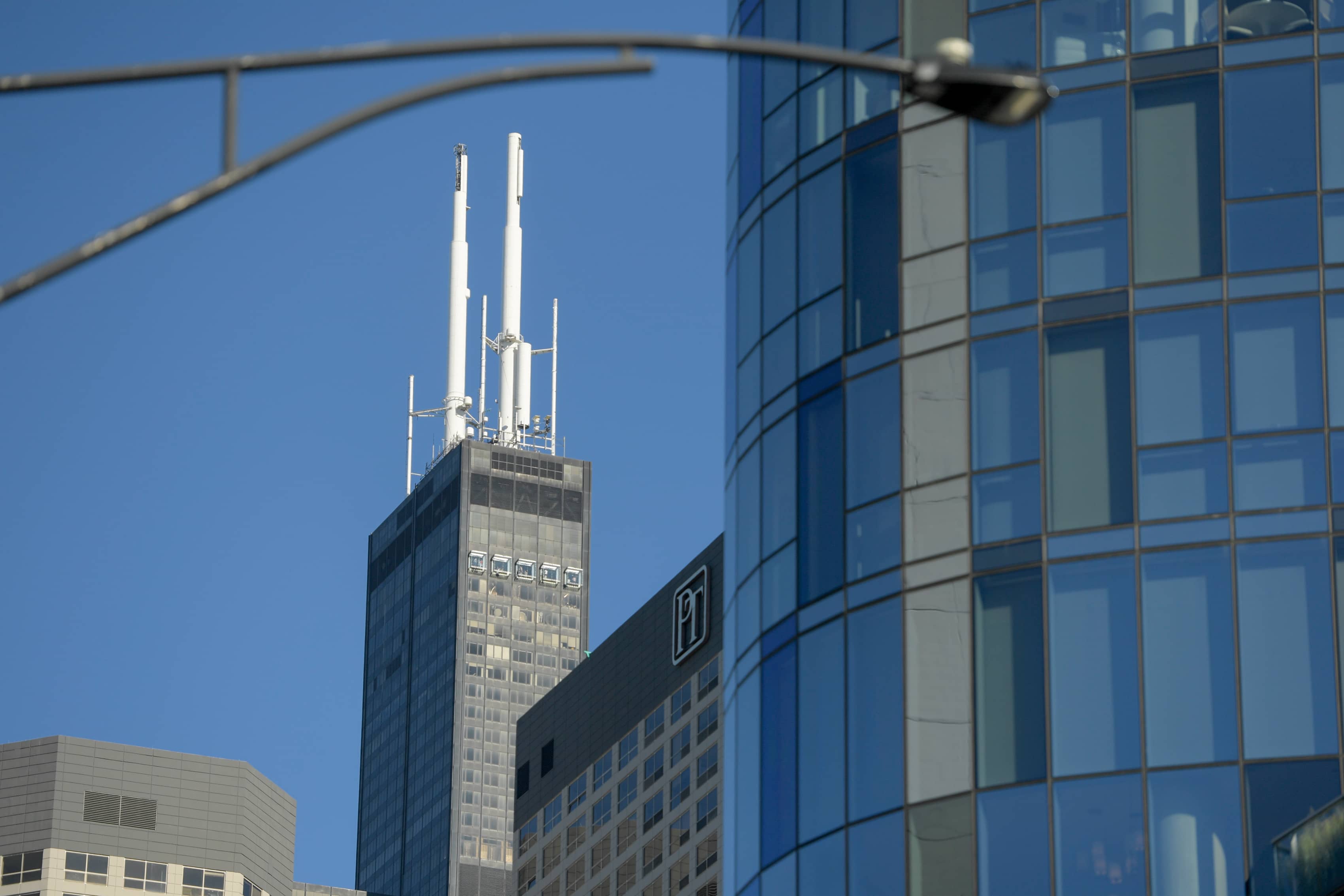
The Latin School of Chicago, Francis Parker, Shipley, and thousands of other National Association of Independent Schools (NAIS) members could lose their non-profit status
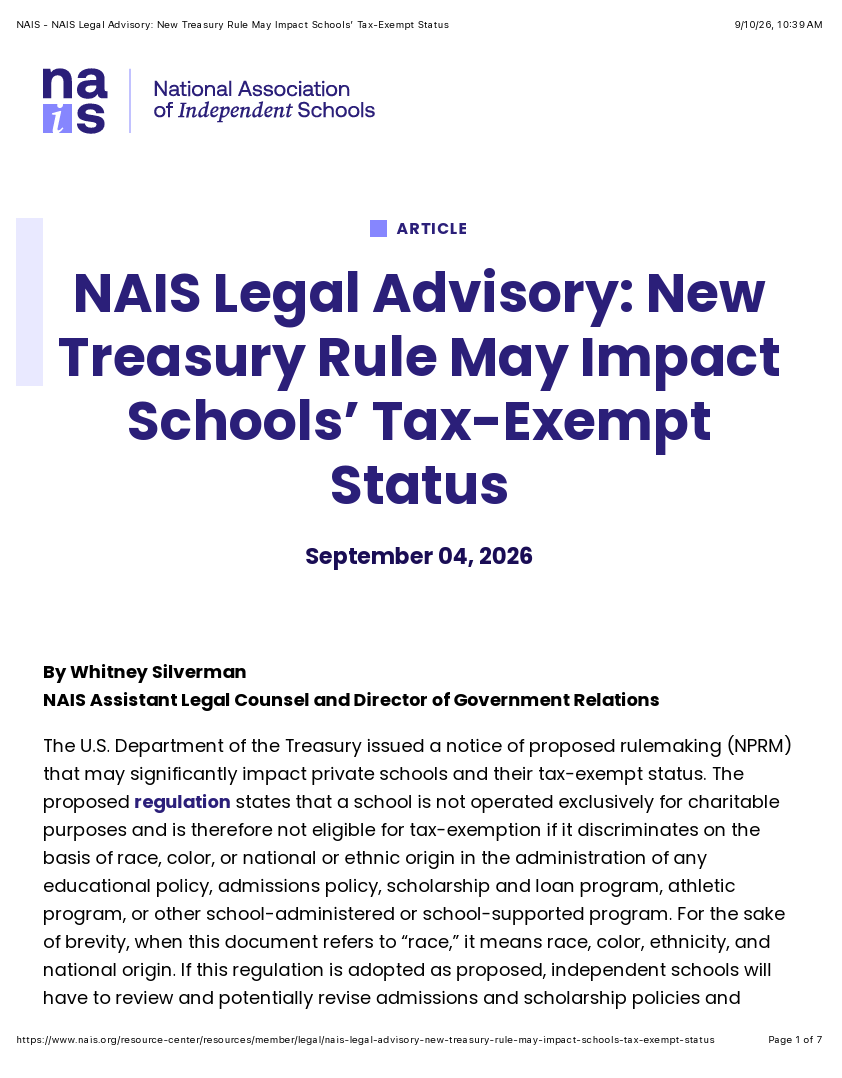
The trade association that writes the DEI playbook for Latin, Parker, Shipley, and hundreds of other private schools just told its members, in writing, that they are probably breaking the law, and that the schools, not NAIS, are the ones facing liability. In a document obtained exclusively by Chicago Contrarian, NAIS warned its members that the bill for its DEI recommendations — actually, its requirements for remaining a member in good standing — is coming due. Specifically, the schools, not NAIS itself, will pay the price unless they stop discriminating on the basis of DEI and “Belonging and Connection,” among other catch phrases for treating different racial and ethnic groups “equitably” rather than equally whether in the classroom or on the payroll.
Most parents who send their children to private or parochial schools never give much thought to the fact that the checks they write are to a 501(c)(3) charitable organization. This means these institutions must follow specific rules to maintain their tax-advantaged status, which lets them pay no Federal income tax on tuition or endowment income, while enabling parents and alumni to make fully tax-deductible gifts to the annual or capital campaigns.
The business model is entirely dependent on the charitable, non-profit structure of these organizations.
For example, The Latin School of Chicago tells parents that its nearly $50K tuition only covers 85 percent of the school's overhead, and that giving pays for one of every five school days. Yet the US Department of the Treasury is moving to kill the tax exemption entirely for schools like Latin and Francis Parker, institutions which are "flagrantly violating the law, by their own admission," according to a local philanthropist with close ties to the Chicago private school community.
The proposed regulation (REG-119986-25) observes that a private school is not operated for charitable purposes if it "adopts, maintains, or enforces any policy or practice that discriminates on the basis of race, color, or national or ethnic origin" in any educational policy, admissions policy, scholarship program, athletic program, "or other school-administered or school-supported program."
"The operative concept here is 'any purpose,' and good intentions are not an excuse," the donor suggests. The proposed regulation suggests that racial discrimination in education is against fundamental public policy "regardless of the intent behind it," including where it is "defended as serving remedial or diversity-related objectives."
18,000 schools are in scope
Schools that fail lose exemption for taxable years beginning after May 31, 2027. The IRS estimates 18,000 schools are in scope. These schools didn't all suddenly decide to start breaking the law individually. They followed their standards organization, the National Association of Independent Schools. NAIS is the trade group for Latin, Parker, Shipley, and hundreds of other private schools.
NAIS does not merely encourage DEI among its members. It embeds it in the "Principles of Good Practice", and membership in NAIS is contingent on agreeing to abide by them. For example, a dedicated "Principle for Equity and Justice" tells member schools they are expected to build "diverse, inclusive, equitable, and just communities" and to put that commitment into their "defining documents."
To join NAIS at all, a school must show a commitment to diversity "evident in all nondiscrimination policies for admission and hiring," which in its applied Orwellian sense actually means the opposite: penalizing those who are "privileged" and favoring those who are not (entirely based on demographic criteria, not socioeconomic status).
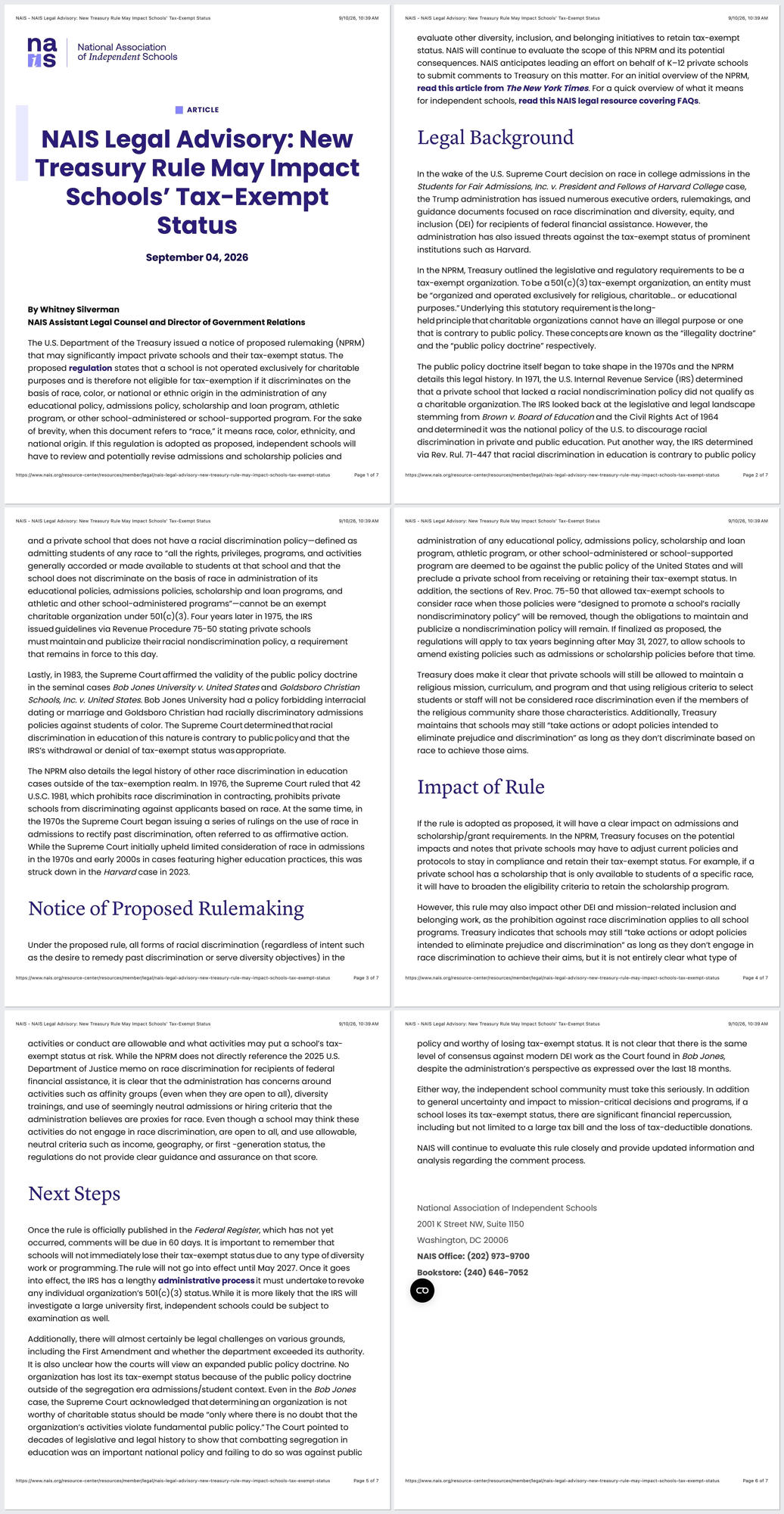
In a September memorandum obtained by Chicago Contrarian, NAIS told its member schools that they "will have to review and potentially revise admissions and scholarship policies." For example, a race-restricted scholarship "will have to broaden the eligibility criteria," to avoid jeopardizing tax-exempt status.
Scholarships designated for certain applicants and not others based on skin color or ethnic background are not the only item in the crosshairs of the IRS: "affinity groups …diversity trainings, and [the] use … admissions or hiring criteria that the administration believes are proxies for race," also do not pass the test. Moreover, income, geography, and first-generation status may not save a school either, if the government reads them as stand-ins for skin color or ethnic background. Schools that lose their exemption, NAIS is warning its members, will likely face "a large tax bill and the loss of tax-deductible donations."
"It's a strange irony that NAIS, the very institution that required discrimination by its member schools to remain in good standing, is now advising schools to unwind these programs," says the local philanthropist.
The programs that NAIS has encouraged its members to follow have resulted in anti-meritocratic environments which have also penalized Jewish families across campuses from New York to Los Angeles. "Like Harvard, NAIS encourages the sorting of groups into oppressor and oppressed, and in that framework Jews, especially those that support Israel, must systematically be discriminated against to atone for their white privilege," the Contrarian’s source suggests.
At the NAIS People of Color Conference in December 2024, speakers, including the keynote address to the entire audience, called Israel a racist project and accused it of genocide, and Jewish students reported hiding their Stars of David. The ADL and AJC called the NAIS event a hostile environment, and even though the organization expressed "profound remorse," quietly pausing the conference for 2025, citing the "rapidly evolving political and legal landscape," it brought it back for 2026, rebuilt around "inclusion and belonging" and "identity-based gatherings," which are precisely the illegal elements Treasury is calling out with their new IRS guidance.
Latin, Parker and Shipley have given the government all the evidence they need to lose their non-profit status
Following the advice of NAIS to remain in good standing, Latin, Parker and Shipley – schools Chicago Contrarian has covered extensively in recent years for everything from parental lawsuits to drag queens to demonstrating anal lube in the classroom to blatant anti-Semitism – put into writing the very discriminatory programs the IRS will use to evaluate their non-profit status.
For example, Latin included a numbered institutional goal: Hire and retain more faculty and staff of color, with action steps instructing the school to build "pipelines of faculty and staff of color" and to run implicit bias training for everyone on a hiring committee. A separate goal at Latin targets inclusion for "Black and Latino/Latinx" students specifically. While its published racial hiring goal does not decide non-profit status by itself, it is direct evidence that remains on the school's website. Moreover, Latin has already been sued this year over alleged sex discrimination, which, while a different protected class than race, has the same legal exposure.
Parker's diversity statement says its commitment to diversity "informs its approach to admissions and hiring," and its principal committed the school in 2020 to operating "as an anti-racist and anti-discrimination institution," tying its Belden Avenue school expansion to a student body "more representative of the diversity of the City of Chicago."
And Shipley built out four DEI coordinators and community programming around Ibram X. Kendi's "anti-racism" concept, which requires treating blacks and other "less privileged" groups "equitably, not equally." While the board was forced to remove its head of school and DEI Director for blatant anti-Semitism, it rebranded its DEI program to "Belonging & Connection," with much of the old guidance intact even as of September, 2027.
The Treasury Department has realized that "diversity policies, which explicitly discriminate against specific parties to favor other ones, but are labeled 'inclusion and belonging,' are no different than those labeled DEI," Contrarian's source suggests. "But these schools have exposure now beyond the IRS, and parents need to realize their annual giving checks are likely to go to plaintiffs and lawyers defending the schools from lawsuits."
A related concern of a board member at a private school Contrarian spoke with is, "the years of unfunded liability schools have been accruing,” from discriminatory practices. A teacher, coach, or applicant who was passed over while the school optimized for "people of color" can go to the EEOC under Title VII or straight to federal court under Section 1981, plus the Illinois Human Rights Act in Illinois or a similar Pennsylvania statute at Shipley.
Chicago's schools are jeopardizing their future
Latin's annual budget is about $61 million (including $4.6 million in giving contributions and a $39 million payroll). Parker received $10.2 million in gifts last year, representing 18 percent of revenue, and says its new building depends on fundraising. Yet none of these gifts will be tax-deductible via a donor-advised fund (DAF) or direct contributions if these organizations lose their 501(c)(3) status.
Latin and Parker have until 2027 to comply with the law. Schools that do so by then will be in compliance. Yet organizations like Shipley, which just changed the headline on their DEI page to “Belonging and Connection” in time for the 2026-2027 school year, appear to be keeping existing practices in place. And Latin has made clear it has no intention of changing course.
In April 2025, Latin's student newspaper reported the school was bucking the national trend against DEI, with then-Head of School Thomas Hagerman stating: "Unlike many other institutions, Latin doesn't face the prospect of losing significant federal funding. As a result, we are able to further the mission-aligned work we are doing to cultivate an inclusive learning environment."
Nine months later, Hagerman was gone. Yet the DEI program remains, even as annual giving at Latin has declined 40 percent from its peak.
Regardless of institution, before parents raise their paddle at the annual fundraiser, they should ask the head of school one question: what, specifically, are we changing, and when? And depending on the answer, the follow-up is simple: can you guarantee a donation is tax-deductible?
J.D. Busch is an investor, entrepreneur, and author. He is currently writing the book Who Killed the Preppy: The Fall of the American Prep School. J.D. wrote his master’s thesis at Penn on American private schools between the World Wars. He was a scholarship student at Shipley, and later a parent at other prep schools.
Further Coverage:
How NAIS Took Over Elite Education
Who Killed the Preppy: The Global Citizen
Latin School of Chicago Head of School Exit Raises Questions About DEI-First Governance Models
The Latin School of Chicago in Shambles
Latin School of Chicago Named in Yet Another Lawsuit
Bernard Zell Anshe Emet Day School: Go Woke, Lose Students
Even “Loving” Chicago Private Schools Tolerate Intolerance by Woke Faculty
Bernard Zell Anshe Emet Day School “Replaces Maimonides with Marx”
