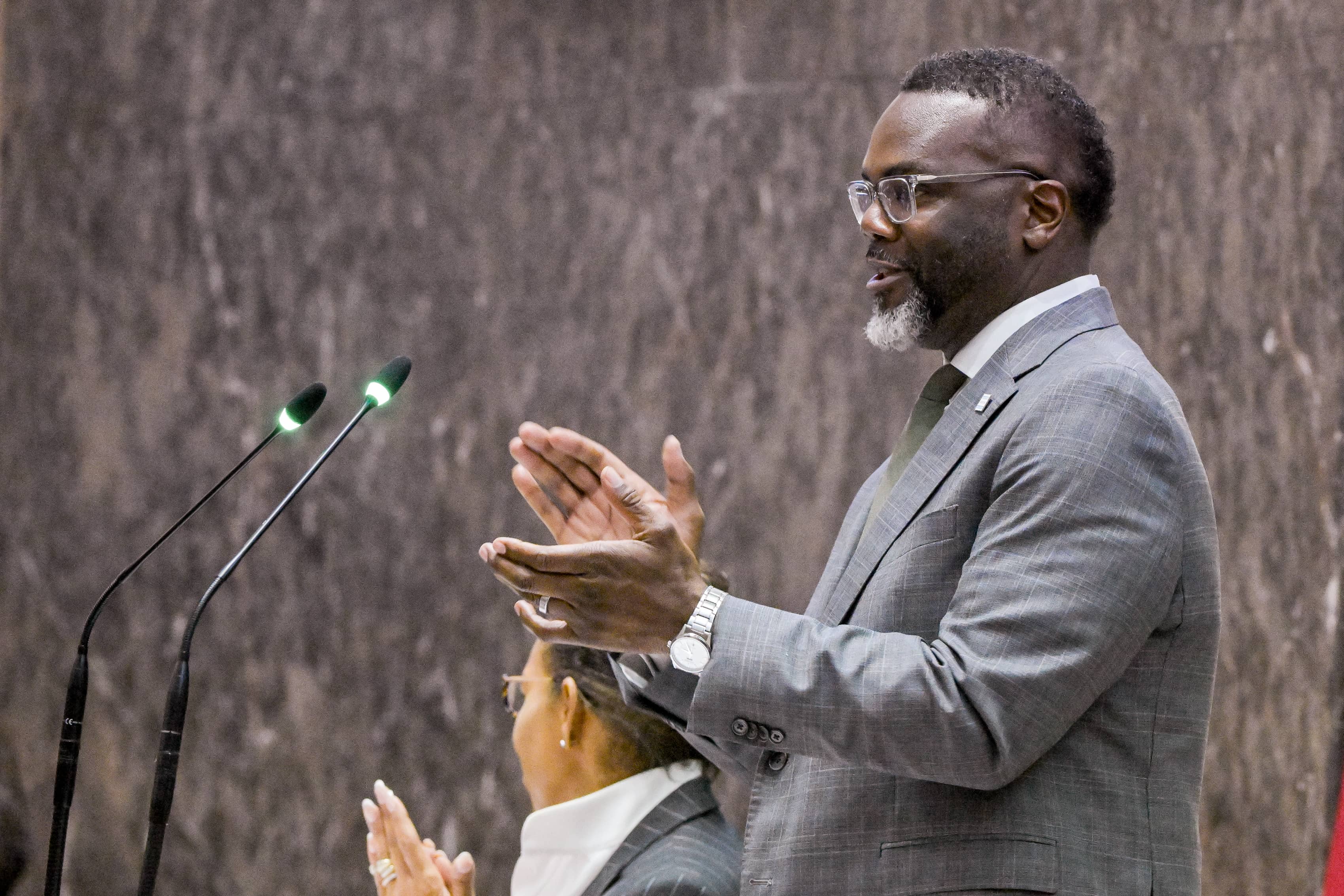
In Brandon Johnson, we've learned the reality has never come close to meeting the expectations and promises
Mayor Brandon Johnson is Chicago's flim-flam man — a swindler and a con artist whose promises have not been matched by his actions, and whose actions have inflicted untold damage on the very communities for which he claims to be fighting. He has only intensified his rhetoric about being a champion for working families and addressing historic inequities, while mischaracterizing his opponents as captives of billionaires and corporate interests.
Consider:
- His much-ballyhooed "Treatment Not Trauma" program has resulted in services being restored at only three of the six mental health clinics Rahm Emanuel closed in 2012 — a fraction of the 19 clinics the city once operated.
- His crisis response teams, the Crisis Assistance Response & Engagement Program (CARE), created to take mental health emergencies off the plates of the Chicago Police and Fire Departments saw their own call volume collapse by nearly 70 percent last year — leaving police and fire responsible for the vast majority of these calls after all. And the program still doesn't operate after 4:30 p.m., or on evenings, weekends, or holidays.
- His promise of nearly 10,000 affordable housing units has, by his own administration's accounting, produced a small fraction of that — with individual projects costing as much as $884,000 per unit, and a citywide average still running a whopping $568,000 to $747,000 per unit.
- The 200 additional detectives he promised remain roughly 150 short, while Johnson touts improved arrest rates that in fact remain stuck at 25 percent for murder and just six percent for non-fatal shootings — figures worlds apart from the inflated "clearance rate" his department prefers to cite.
- The failure to replace the ShotSpotter gunfire-detection system — which was conveniently terminated just weeks after the Democratic National Convention left town — has been linked by CWB Chicago's reporting to delayed police responses in the shootings of 84 people, whose fatality rate ran nearly three times the citywide average.
- He lies about holding the line on property taxes, which last year alone grew by $569 million on homeowners and apartment owners combined — with commercial property owners, notably, paying less.
- His latest claim of a record increase in summer jobs for city youth amounts, at best, to a return to pre-COVID levels — a point even the Chicago Tribune's editorial board has made.
- His reestablishment of a city Department of Environment has so far been largely in name only, launched with just $1.8 million and 14 staff and no real enforcement mandate.
- Johnson has done little to accelerate replacement of Chicago's brain-damaging lead pipes — the most of any U.S. city, with the city's own plan not projecting full replacement until 2076 — or to ensure low-income residents have the water filters they need in the meantime.
- His Office of Reentry Services, created in his own first budget, launched with just four staff and $5 million — a rounding error next to the departments it's meant to support. Another box checked, rather than a program built.
Two promises the mayor has delivered on, to the detriment of Chicago residents:
The first: His prioritizing the agenda of his former employer, the Chicago Teachers Union, which has meant the city providing additional funding to help pay for the union's contract, valued at roughly $1.5 to $1.6 billion. Johnson has given schools a record $552.4 million in property tax revenue from the Tax Increment Financing program for next year alone, in addition to a school district share of citywide property taxes that has climbed past 55 percent, up from under 47 percent a decade ago.
The second: His "Sanctuary City" policies, which have seen the city commit more than $625 million to supporting migrants since 2022, while a Wirepoints analysis estimates the school district has spent an additional $215 million to $410 million educating migrant students. It's hard not to see the city's direction as one of managed decline: While the data on who exactly is leaving and who is arriving is contested, city policy has done far too little to keep middle- and upper-income families from choosing to leave.
The State of the City
As the Mayor and Aldermen enter election year, the city finds itself facing a major financial crisis despite its residents and businesses paying among the highest taxes, fees, and fines of any U.S. city.
Worst finances
Chicago faces a structural budget deficit for FY 2027, estimated at anywhere from $680 million to $1.2 billion, depending on which projection you believe, while Chicago Public Schools face at minimum a $732 million deficit of its own — even as the district, along with the Mayor's former employer, the CTU, demand additional funding. Chicago's retirement funds for police, firefighters, and other city workers are among the worst-funded in the nation, currently around 24-26 percent funded and projected to fall toward 18 percent for Police and Fire under recently signed pension legislation. The city spends over 40 percent of its budget on debt service and pensions — nearly double what New York and Los Angeles spend.
Slowest economic growth
Chicago's real GDP growth has averaged under one percent annually, among the slowest of the 25 largest U.S. metros. The metro area is a diminishing powerhouse: Real wages have dropped nearly eight percent over the past several years, even as nominal pay rose — inflation simply outran it. While national employment has climbed nearly five percent since before COVID struck, Chicago's has grown less than two percent over that same span and has essentially stalled over just the past year — leaving the metro area far behind competitors that have added tens or hundreds of thousands of positions.
Highest cost of government
Chicago is among the highest-taxed major cities in America. It ranks near the top for both sales and property taxes. Its combined state, county, and city sales tax of 10.25 percent is already among the highest in the nation, second only to Seattle — and is set to become the outright highest in June 2026. Its hotel tax reaches 19 percent at large downtown hotels, also the highest in the nation. Its effective commercial property tax rate runs roughly double the national big-city average. Beyond that, the city imposes more than 30 individual taxes and fees.
Nation's crime capital
Chicago continues to lead the nation in the number of murders, non-lethal shootings, mass shootings, and school-age youth murdered and wounded. The disparity with Chicago's immediate neighbors is staggering: With a far smaller population than its collar counties, Chicago recorded seven times more murders than DuPage, Lake, Will, Kane, and McHenry counties combined, and roughly 10 times more shooting victims, according to a Chicago Contrarian analysis.
Among the worst in equity
Chicago consistently ranks among the most economically and racially segregated cities in the United States, placing among the five most segregated large cities in the nation for decades. High-income earners make roughly 5.5 times as much as low-income earners. Meanwhile, University of Illinois Chicago researchers have found the share of city neighborhoods classified as middle-income has fallen to just 16 percent, while lower-income neighborhoods now account for 62 percent — showing a hollowing-out of the city's middle class.
Greatest longevity gaps
According to the Chicago Department of Public Health, Chicago has among the largest life expectancy gaps between neighborhoods of any major U.S. city. In 2023, Asian/Pacific Islander residents lived on average to 86.8 years, compared to 71.8 years for Black residents. The Loop's life expectancy reached 87.3 years, while residents of West Garfield Park averaged just 66.6. These 20-year-plus disparities are inseparable from environmental and public health inequities.
The elimination of quality school choices
Johnson has advanced the CTU's agenda of eliminating quality education choices for poor families. He was a paid CTU employee when the union successfully lobbied to let the state's private school scholarship program for low-income families expire at the end of 2023, and as mayor he has continued in lockstep with the union — most recently when the Chicago Board of Education, with his appointees, voted unanimously this spring to urge the governor to reject Illinois's participation in a new federal school-choice tax credit. Meanwhile, the Mayor has supported the CTU's efforts to degrade and ultimately eliminate public school choice as well, by shifting funding away from high-performing schools and imposing burdensome mandates.
Don't expect things to change. According to the Mayor, the city is well on its way to becoming the safest, most affordable big city in America — even as he continues to wrap himself in progressive rhetoric. At a press conference this month, he said:
"The progressive movement is alive and well. We just have a few obstinate individuals that are more aligned with the interests of corporations that are ultimately stalling what could be a full-out revolution in this city, and the people of Chicago want it."
One thing is certain: The Mayor's approach will continue to be dictated by CTU leadership, to whom he is ideologically aligned and on whom he depends for organization and money, and by his far-left allies in the City Council. Continuing to subsidize the schools to help pay for the teachers union's record contract, protecting CTU members above all else, and continuing to treat migrants as if they are entitled to city benefits Chicago cannot afford — a combination that spells catastrophe for this city.
