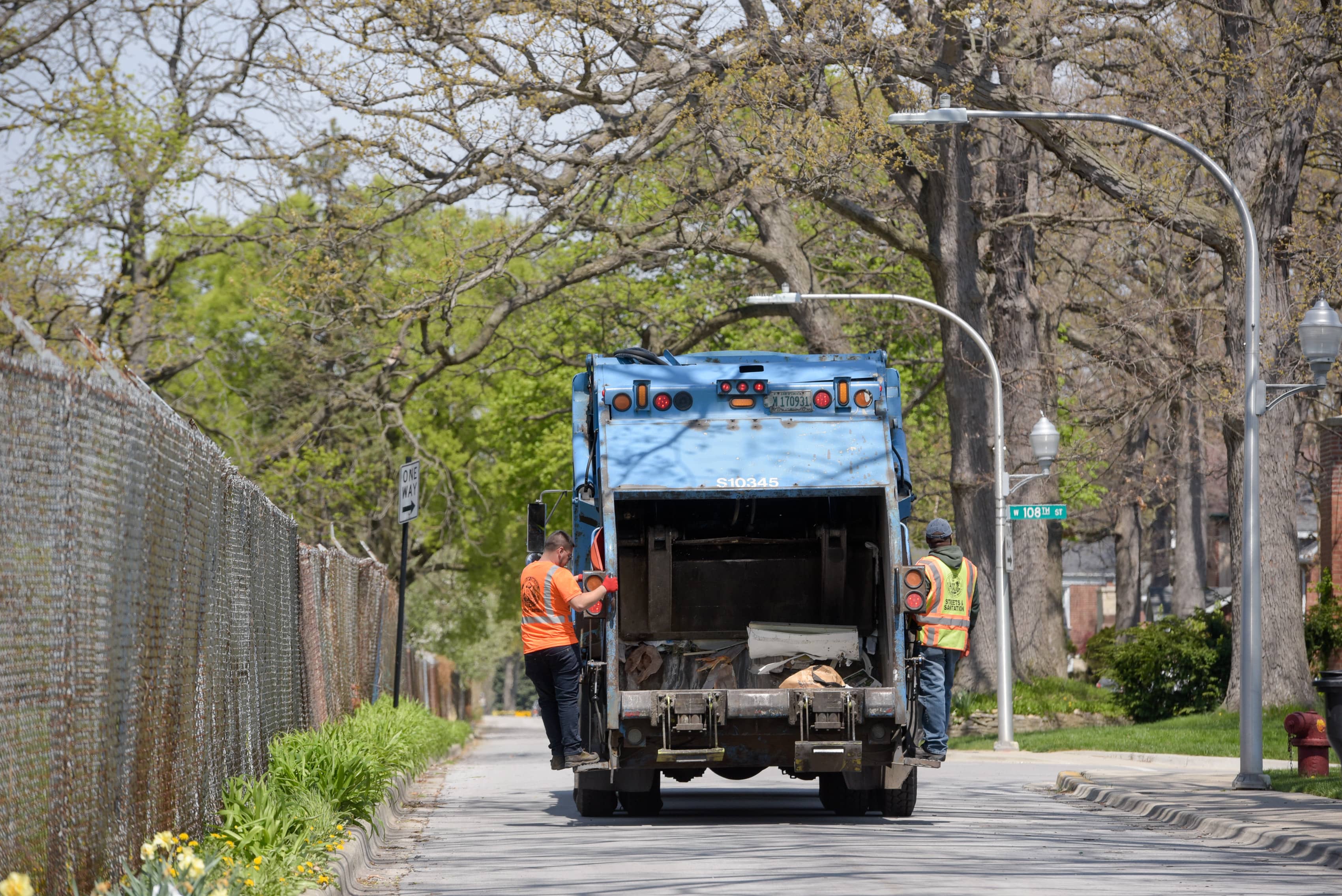
No one notices until it snows
Chicagoans, outside of Bridgeport residents, rarely think about the Department of Streets and Sanitation (DSS) until the garbage is not collected, the alley is buried in snow, a rat appears in the backyard, or a dead tree threatens the garage. Yet DSS is one of the city’s larger operating departments, with a budget approaching $350 million and responsibilities sprawling from garbage collection and recycling to forestry, rodent control, street sweeping, snow removal, and auto pounds.
It is also an unusually good place to ask a basic question that the Chicago government prefers not to deal with. What does it actually cost the city to provide a service, and could somebody else provide the same service at lower cost without sacrificing reliability?
That question is not automatically synonymous with privatization. Chicago has already learned the hard way that merely handing a service to a contractor does not necessarily produce efficiency. In this case the more useful concept is competition.
DSS performs work that, unlike policing or fire protection, has readily available private-sector comparisons. Private companies collect garbage throughout suburban Chicago. Contractors remove snow, trim trees, tow vehicles, and haul recyclables. That means many DSS functions have something government programs often lack. That is an observable market price. Chicago experimented with precisely this idea under Mayor Rahm Emanuel.
In 2011 the city divided its recycling operation into geographic zones, leaving two with municipal crews and assigning four to private operators. City workers and private contractors would effectively compete. The Federal Reserve Bank of Chicago reported in 2012 that operating costs under the new system had fallen 31 percent from the previous arrangement, while city-crew costs had fallen 21 percent. The experiment appeared to offer something better than ideological arguments over public versus private employment. It provided the possibility of measuring each against the other.
Then Chicago committed one of its familiar sins. It largely stopped measuring. Imagine that! Well, knock me over with a feather!
The Better Government Association (BGA) later found the comprehensive evaluation promised when managed competition began was never completed. The city had not maintained enough of the underlying information to determine rigorously whether municipal workers or contractors were delivering the better combination of cost and performance. The competition continued, but nobody ever properly declared a winner. That history contains lessons for any renewed examination of DSS. You would think since the Chicago failed at managing the evaluation then privatization of DSS would be a no-brainer. It is not quite as clean as that, however.
The first is that privatization is no substitute for management. A badly designed public operation does not automatically improve when its workers begin wearing a private company’s uniform. Contracts have to contain measurable performance requirements. Somebody at City Hall must verify whether those requirements are being met. There is no AI bureaucrat yet.
Recent Inspector General (IG) reports reinforce the point. In July, the IG concluded that DSS’ rat-control program remained largely complaint-driven rather than organized around long-term prevention. The office recommended a more coordinated, data-based approach aimed at sanitation conditions and other causes of infestation.
A month later, the IG examined city auto pounds. Chicago maintains eight pound operations at five locations, with responsibility divided among the Police Department, DSS, and a private towing contractor. The audit found unreliable digital records, inconsistent procedures, weak monitoring of contractor requirements, and inadequate tracking of vehicle-damage claims. In a sample examined by auditors, the city could not determine the disposition of 15% of vehicles.

The lesson is inconvenient for advocates on both sides. Government operation does not guarantee accountability. Neither does outsourcing. The better framework would begin with full-cost accounting.
The salary of a sanitation laborer is not the cost of employing a sanitation laborer. The City also incurs health benefits, payroll taxes, equipment costs, supervision, overtime, and pension expenses. Administrative overhead has to be allocated as well. Likewise, a private bid cannot be judged merely by the contractor’s stated price if the city must maintain inspectors, emergency equipment, or backup crews to make the contract work.
The Chicago Fed made exactly this point when examining managed competition. Proper comparison requires counting the full employee cost, including benefits and indirect overhead, and establishing performance standards before bids are compared.
Garbage and recycling are especially suitable for such measurement. Cost per household can be calculated. Missed collections can be counted. Tons collected per crew can be compared. Complaints, equipment downtime, and contamination rates can be published.
Chicago’s recycling history shows why the quality measure is as important as price. The BGA found in 2018 that less than nine percent of residential waste was being recycled and that one private contractor was labeling bins contaminated at vastly higher rates than other providers. The contractor was paid for collection while some rejected material eventually went to a landfill operated by the same company. The issue was not that contracting was inherently defective; it was that Chicago had failed to build and enforce a sufficiently rigorous measurement system. It’s doubtful that many Chicagoans will lose sleep over the failings of recycling but there should be some accountability, nevertheless.
Snow removal presents a different problem. In 1979 a blizzard paralyzed the City. There were many other, perhaps not as widely publicized, disabling blizzards since. A private garbage company can schedule predictable routes. A Chicago blizzard requires hundreds of trucks and workers to be redeployed within hours. The city maintains a workforce partly because that workforce can be shifted when an emergency arrives. The Chicago Fed noted this problem while discussing privatization. A contractor that looks inexpensive during ordinary operations may not have enough spare labor and equipment for floods, snowstorms, or other emergencies. That argues against treating DSS as a single operation.
Garbage collection might lend itself to managed competition. Recycling clearly does. Tree trimming and certain forestry work can be benchmarked against contractors. Towing and auto-pound operations already combine public and private providers. Rodent control may require closer integration with city inspections and sanitation enforcement. Snow removal has an emergency-response characteristic that makes wholesale outsourcing more difficult. The sensible comparison, therefore, is not “privatize DSS” versus “keep DSS.” It is function by function.
Then there is the elephant in the room. That is, of course, pensions. DSS workers participate in Chicago pension systems whose obligations do not appear directly in the department’s annual operating budget. A private company ordinarily includes retirement compensation in the price it charges. Chicago’s true labor cost is spread among departmental appropriations, citywide benefit accounts, and pension contributions.
Ignoring those costs can make public labor appear artificially inexpensive. Conversely, assigning the entire city pension debt to current DSS workers would make them appear artificially expensive. Legacy pension debt represents promises accumulated over decades and cannot fairly be charged entirely against today’s garbage route.
The answer is actuarial normal cost. What does employing one additional worker today add to the city’s long-term retirement obligations? That calculation would permit genuine competition.
Chicago could divide appropriate services into districts, publish detailed performance requirements and invite both city crews and private companies to bid. Municipal bidders would be charged wages, benefits, pension normal cost, equipment, and overhead. Contractors would include profit, insurance, equipment, and required emergency capacity. Chicago could then publish the results on a quarterly basis. Cost per household. Cost per ton. Missed pickups. Complaints. Recycling diversion rates. Equipment availability. Response times.
The winning model might differ by service. City workers could prove cheaper in one operation and contractors cheaper in another. That would not represent failure. It would be the point of the exercise. Any government operation that is shielded from competition becomes fat, lazy, and inefficient. Public schools anyone? Chicago tried something close to this more than a decade ago under the Emanuel administration.
The numbers suggest competition itself drove costs lower, including costs among municipal crews. What disappeared was the discipline to keep score. A department approaching $350 million does not necessarily need to be dismantled. Its performance, however, ought to be measurable.
For Chicago taxpayers, the most useful reform may begin with a simple question. What is the true cost to pick up the garbage and remove the snow?
