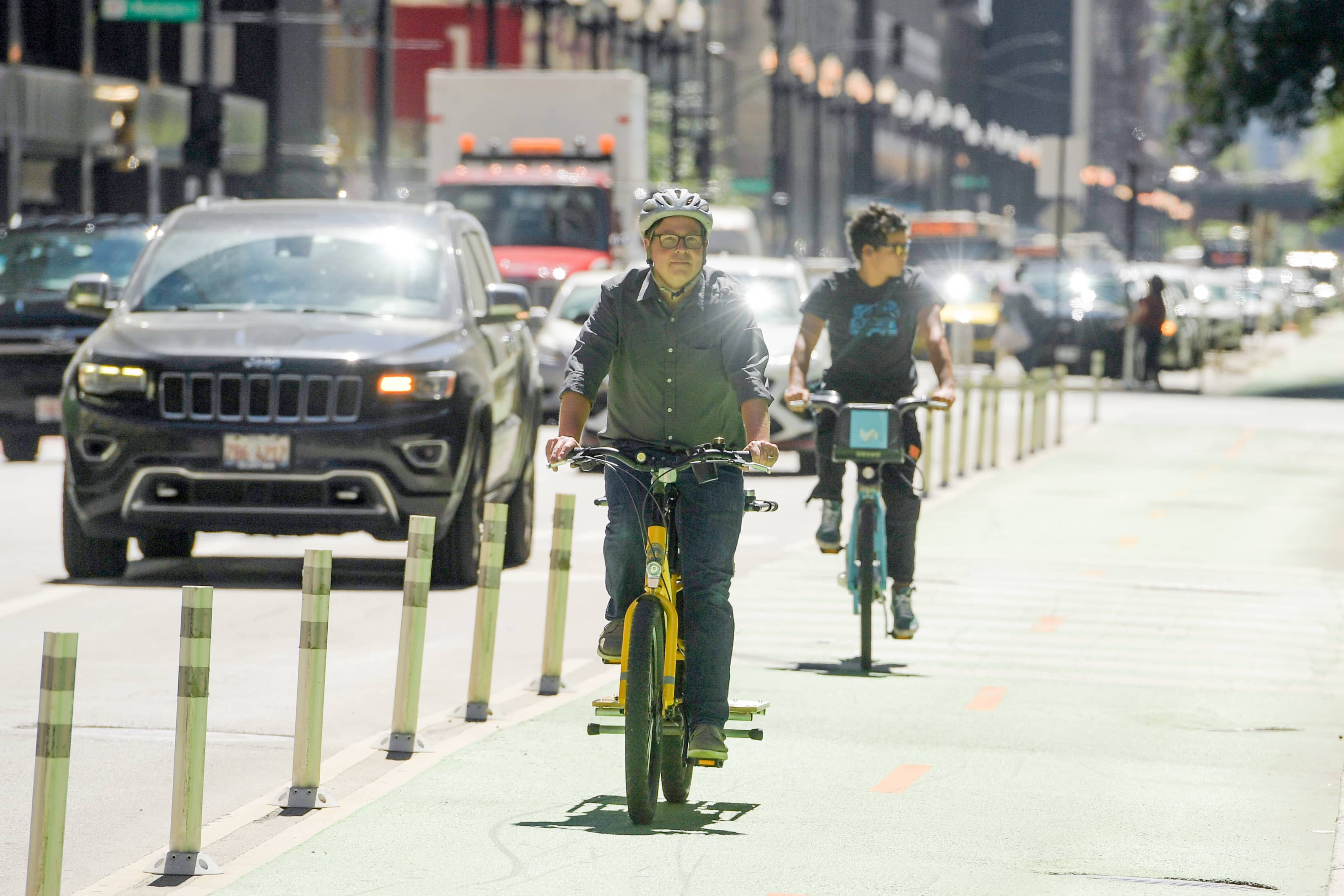
Protests against bike lanes in Chicago might portend political change
“And it was inevitable that some of these people pushed back.” Ray Bradbury, The Martian Chronicles.
About 20 years ago, a self-appointed few, a sanctimonious “elect,” to borrow a religious term, decided American cities needed to be transformed so that every major urban thoroughfare has bicycle lanes.
This nasty and unhappy few regularly shows up at public meetings, issuing their heckler mandates, which weak-willed public officials usually bow down to, sometimes simply just to shut off the noise.
Still, many progressive politicians support building more bike lanes, even though most residents are indifferent to them, or are in opposition.
That latter group is growing.
Meanwhile, about 70 percent of households in Chicago own at least one automobile.
Two years ago, The Chicago Sun-Times reported, “2.5 million people a day in Chicago make more than 8 million total trips — including by car and all modes of transportation.”
How many were of those trips on bikes?
Only 2.5 percent, or just 200,000 trips, according to the Sun-Times. For comparison, in the 2016 presidential election, Libertarian candidate Gary Johnson received a higher percentage of the popular vote than that.
Yes, bike riding might be growing in popularity in Chicago, but the base it started from is quite small. And the sky is not the limit for regular, non-workout cycling in Chicago. Winters are cold here and summers are hot and humid. It rains. And who wants to sit in the cubicle next to the smelly B.O. guy who commutes to work on his bicycle?
I’ll give “the Bike Mafia” credit: They have skillfully leveraged their small numbers into an effective political force.
For now.
The pushback
Residents of Brighton Park on the Southwest Side intuitively recognize the math, and they are pushing back with weekly protests against protected bicycle lanes on Archer Avenue between 47th Street and Western Avenue. The pro-bike lane crowd organizes counter-protests.
The Archer Avenue project is part of Chicago’s Complete Streets Program. The Archer bike lanes project so far has cost taxpayers $4.7 million.
Brighton Park is in the 12th Ward. Its alderman is Julia Ramirez. She sides with the cyclists, and she is a member of the City Council Progressive Reform Caucus. Ramirez is typical of that ilk. Before she was elected to the City Council in 2023, she was a social worker for Chicago Public Schools. Her focus there was community activism. Which means that generally any of her few accomplishments are destructive.
An article by Jake Sheridan in the Chicago Tribune, which was published on a new dump period — in this case, Memorial Day — generally sided with the Bike Mafia. There were some good passages, however, including an interview with a Brighton Park resident who has more common sense than Ramirez.
“Maria Martinez, a regular at the ritual protests, said she became involved after driving down the street, seeing the construction and feeling like the bike lanes were a bad fit for the neighborhood of working families. She felt compelled to show up after being muted during a virtual meeting, she added.
‘We weren’t able to speak. They just spoke about numbers and statistics and a bunch of mumbo jumbo,’ she said. ‘You can’t put your two, three kids on a bike, especially in winter. Like, when it’s snowing, who rides their bike in the snow?’”
Critics of bike lanes include many people like Martinez — as well as business owners. Bicycle lanes often remove street parking spaces set aside for retail customers. Also, sometimes traffic lanes are narrowed or even removed from streets. The former lanes are replaced with flex cones and concrete bumpouts, which increase congestion.
Those bumpouts, which are obscured after even moderate snowfall, damaged some municipal snowplows last winter, as well as some passenger cars and SUVs.
Bike lane supporters reflexively fall back on studies that claim bike lanes don’t harm, or, may even improve business sales in protected lane areas — which is part of that “mumbo jumbo” Martinez spoke to the Tribune about. However, those surveys are usually funded by anti-car organizations.
Narrower thoroughfares mean more traffic ends up on side streets, endangering pedestrians.
Ambulances are also slowed down by narrower through streets, possibly endangering lives.
It’s Trump’s fault
Among the prominent anti-bike lane protesters in Brighton Park are Juan Rangel, the former CEO of the United Neighborhood Organization of Chicago (UNO), who now leads the non-partisan Urban Center, and Claudia Zuno, who is running to replace Ramirez on the City Council.
Rangel’s participation in the protests allows progressives to turn the anti-bike lane protests into an anti-Trump phenomenon, which John Greenfield, of the anti-automobile Streetsblog Chicago, did in an article he wrote last month.
This week, Greenfield turned up the heat by interviewing the bombastic Ald. Byron Sigcho-Lopez (25th), who performed his usual agitator schtick. Oddly enough, Sigcho-Lopez’s involvement with the Bike Mafia might end up helping the other side — he’s that bad.
In that article about Sigcho-Lopez, Greenfield used an opportunity to attack Raymond Lopez, the 15th Ward alderman, who sides with the anti-bike lane protesters. Greenfield said Lopez is “the City Council’s most vocal defender of Trump’s immigration policies.”
The Bike Mafia must know it’s losing the argument on the Archer Avenue bike lanes — so they wedge Trump into the discussion.
I mean, seriously, does anyone believe that, between his sips of Diet Coke, Trump is sitting in the Oval Office saying: “We need to get rid of those bicycle lanes in Chicago, it will be yuge.”
Selective outrage on safety
The Bike Mafia cites the many accidents, some fatal, involving automobiles and cyclists, which they utilize to bolster their argument for protected bike lanes. Of course, these incidents are tragic. But the Bike Mafia for the most part opposes mandatory helmet laws for cyclists. They believe helmet laws discourage bicycle riding and the pro-cycling people want a larger constituency. After all, only 2.5 percent of Chicago trips are done by bike riders.
Cyclists, some wearing helmets and some not, riding on the vast Forest Preserve District of Cook County’s trail network, are well known for their aggressiveness toward and harassment of runners and pedestrians while traveling noticeably faster than the posted 15 miles per hour speed limit, especially down hills and bridges.
Bicyclists are bound by many of the same laws automobile drivers are, including generally having to yield to pedestrians.
Bike rider and pedestrian collisions were common on Chicago’s Lakefront Trail, until local billionaire investor Ken Griffin — a Republican who has since moved to Florida — donated $12 million to pay for separate lanes for cyclists and everyone else.
Safety is a one-way protected bike lane for cyclists. Of course, if you visit Greenfield’s Streetsblog Chicago, you enter a world where bicycle riders are always right.
To be fair, Greenfield suffered a serious injury while cycling in 2023 — and he was wearing a helmet.
But no one is ever always right. And you know what? Many cyclists are insufferable and haughty jerks. And the run of the mill Chicagoan is figuring that out.
If Chicago’s progressive left suffers an electoral setback in 2027 — from the mayor’s office on down — it might be partially attributable to pushing back against the Archer Avenue bike lanes and the Complete Streets Program.
Transformation sometimes starts in a small way.
