Soldier Field: From Civic Coliseum to The Economics of Modern Sports
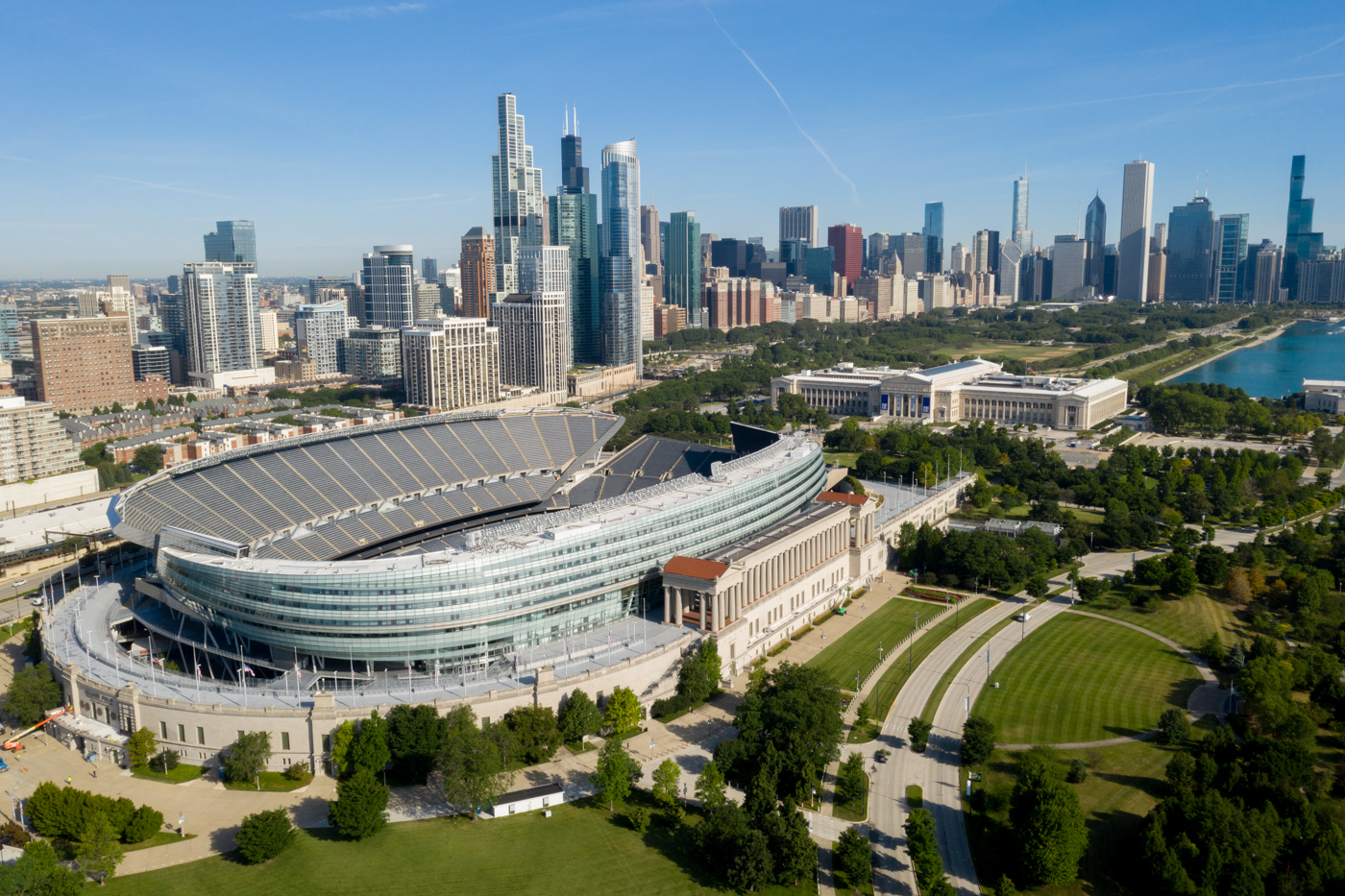
Let the Bears and the McCaskeys go
When construction began on Soldier Field in 1922, Chicago did not imagine a football palace in the modern sense. The city envisioned something closer to a Roman forum on the lakefront, a monumental, multi-purpose civic stadium that would host athletics, pageantry, and public ceremony on a scale befitting what was then America’s second-largest city. It was called Municipal Grant Park Stadium, and it reflected a Progressive Era belief that public infrastructure could shape civic identity as much as commerce or industry.
It was completed in 1924 at a cost of roughly $13 million, which was an enormous sum for its time. The stadium was built with classical colonnades, vast open concourses, and a field designed to be reconfigured for football, track and field, boxing, military reviews, and mass civic gatherings. Profitability was not the point. Scale and symbolism were.
Ownership initially rested with the City of Chicago, but in 1934 control transferred to the newly created Chicago Park District, which consolidated dozens of park boards citywide. The shift formalized Soldier Field’s role as a public asset rather than a municipal enterprise. It would be leased for events, not monetized as a private venue. That decision, made during the New Deal era, would echo through every stadium debate that followed.
The stadium’s coming-of-age moment arrived on November 27, 1926, when Army and Navy met at Soldier Field before a crowd reported at more than 100,000 spectators. The game ended in a 21–21 tie, but the result mattered less than the spectacle. For a moment, Chicago joined the short list of cities capable of staging truly national sporting events. Soldier Field was not merely large; it was symbolic. It was an outdoor cathedral for American athletics and civic rituals.
Throughout the 1920s and 1930s, that ambition was realized across many sports. Soldier Field became one of the Midwest’s most important track and field venues, hosting AAU championships, Olympic trials, and major invitational meets. In an era before television, track stars were national celebrities, and Chicago produced some of the brightest. Jesse Owens competed at Soldier Field during his peak years, thrilling crowds with speed and grace that seemed to defy physics. Alongside him was Ralph Metcalfe, a Chicago native whose Olympic success made him both an athletic and civic icon long before his later career in politics.
Boxing, too, found a natural home on the lakefront. Outdoor championship fights could draw tens of thousands, and Soldier Field’s scale allowed promoters to think bigger than indoor arenas. The most famous bouts came during World War II and its aftermath, when Joe Louis defended the heavyweight title against Billy Conn in 1941 and again in 1946. The first fight, remembered for Conn’s tactical brilliance and Louis’s devastating late knockout, remains one of the most storied contests in boxing history. The second confirmed Soldier Field as one of the few American venues capable of staging heavyweight championship fights on a truly national stage.
Football, however, gradually became the stadium’s gravitational center, aided by one man more than any other: Arch Ward, the influential sports editor of the Chicago Tribune who also created the MLB All Star game. Ward believed Chicago deserved marquee events that matched its stature. In 1934, he created the College All-Star Game, pitting the defending NFL champion against the nation’s best college seniors. Played annually at Soldier Field for four decades, the game turned the stadium into football’s ceremonial opening bell.
Ward’s vision extended even to high school football. The 1937 Prep Bowl, matching Austin High School against Leo High School, drew a crowd widely reported at roughly 120,000 spectators, a number almost inconceivable today for a prep game. The event reflected a Chicago in which neighborhood identity, Catholic League rivalries, and public school pride were mass civic phenomena. Soldier Field functioned as a common ground where the city saw itself reflected at full scale.
Yet, the very forces that elevated Soldier Field eventually undercut its original mission. By the 1950s, television began hollowing out mass spectator sports that relied on live attendance rather than broadcast contracts. Track and field retreated to smaller venues. Outdoor boxing declined as promoters moved indoors for television control. High school football crowds dwindled as audiences fragmented. Soldier Field remained monumental, but it was increasingly underused.
Professional football filled part of the gap, though not immediately in the way modern fans might assume. The Chicago Cardinals played many of their games at Comiskey Park, while the Chicago Bears remained tenants of Wrigley Field for decades. Soldier Field hosted occasional Bears and Cardinals games, exhibitions, and the College All-Star Game, but it was not yet a football home.
Wrigley Field, not Soldier Field, was the Bears’ true base through the 1960’s. Its intimacy suited football better than Comiskey Park’s cavernous baseball geometry. Only in 1971, after modest renovations, did the Bears move permanently to Soldier Field, transforming it from a civic coliseum into a football-first venue.
That transformation culminated in the 2002–2003 reconstruction, a project that cost approximately $690 million and replaced the original seating bowl while preserving the historic colonnades, albeit with what looked like the Starship Enterprise in the middle of the stadium. At least it looks that way as you’re driving down Lakeshore DuSable Drive. Financing relied heavily on public debt backed by the Park District, while the Bears signed a long-term lease that ties the Bears down until 2033. There is an easy out for the Bears that leaves the taxpayers in the lurch. Annual rent has remained modest relative to capital cost. Preservationists decried the loss of landmark status while economists questioned the return on investment. I don’t believe that there is an economic study anywhere that shows the building of a stadium or arena that pays for itself unless it is privately owned. The Bulls and Black Hawks built the United Center with their own resources.
Meanwhile, the business of the NFL changed completely. Franchise values exploded not because of gate receipts, but because of national television contracts, global merchandising, and, more recently, legalized sports gambling partnerships. Teams became media assets. The Bears, valued at roughly $20 million when they moved to Soldier Field in 1971, are now worth north of $7 billion. That’s a 350 fold increase!
Ownership structure matters in this new era. Dallas Cowboys owner Jerry Jones famously financed AT&T Stadium largely with his own capital, underwritten by wealth generated outside football, primarily natural gas investments. The Chicago Bears, by contrast, remain the primary asset of the McCaskey family. Their wealth is tied to the franchise itself, making stadium economics existential rather than opportunistic.
That reality explains the Bears repeated exploration of alternatives, from ambitious lakefront proposals to the purchase of land in Arlington Heights, and even a brief flirtation with Gary, Indiana. Each reflects the same tension: A franchise whose value has skyrocketed in a league defined by private capital, operating within a city whose stadium remains publicly owned and politically constrained. Soldier Field began as a civic monument, not a balance sheet. For decades, it succeeded precisely because it was not optimized for any single sport or revenue stream. Today, that legacy collides with a sports economy driven by television rights, premium seating, and year-round monetization.
Whether the Bears remain on the lakefront or depart for a privately controlled campus elsewhere, Soldier Field’s story remains uniquely Chicago: grand, public-minded, and perpetually caught between symbolism and commerce. It makes no sense to continue to subsidize a family’s rise from the middle class to billionaire status. Should the Bears move, the Park District should sell Soldier Field to the highest bidder.
