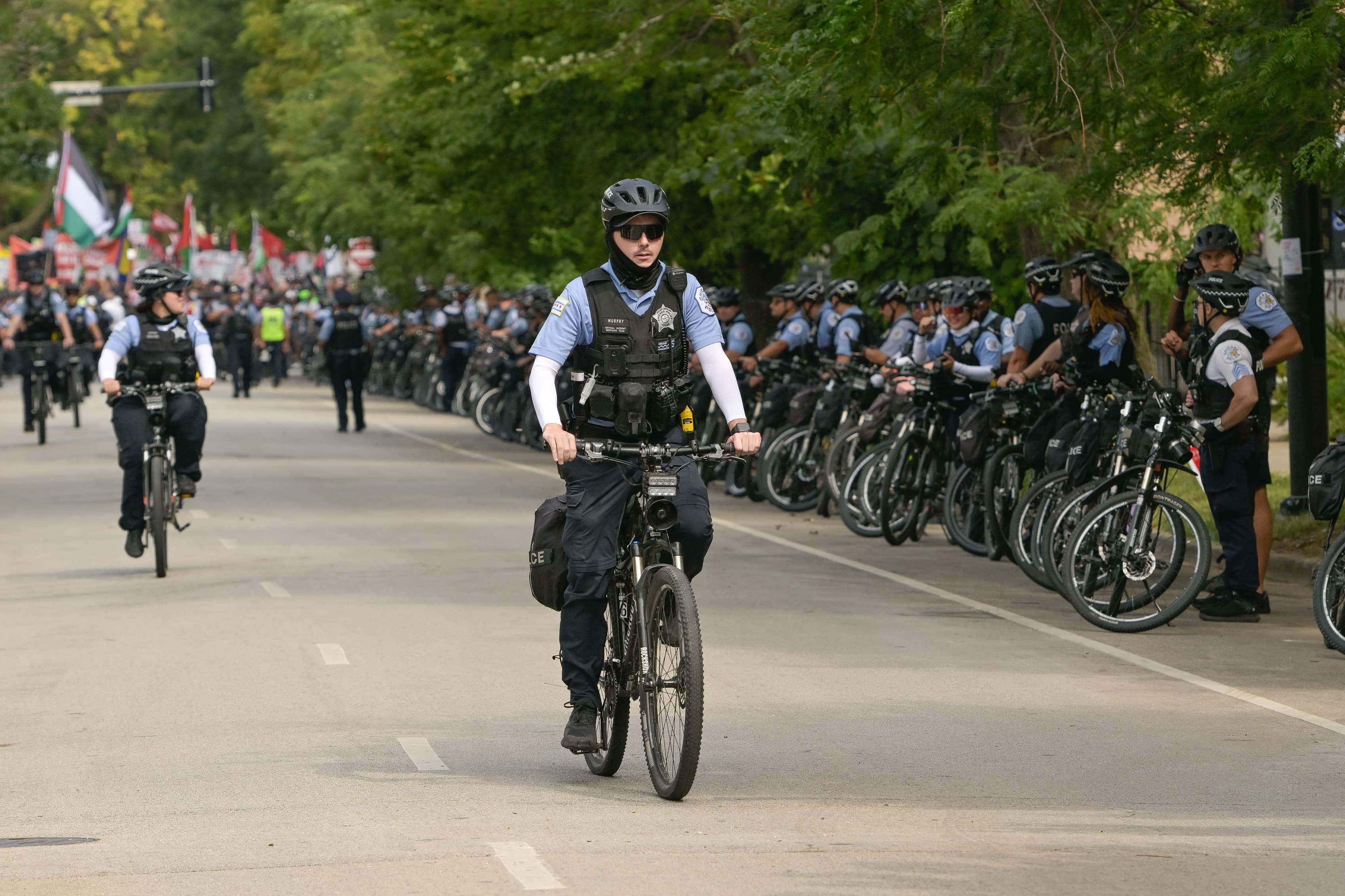
The government's war on the Chicago Police Department
In the bizarro world that is Chicago, the public debate over “use of force” has been turned completely upside down.
In any rational society, the focus of government — and the concern of the public — would be on the people actually committing violence. The goal would be simple: Stop the criminals.
But in Chicago, the obsession is different. Here, the scrutiny falls not on those who pull the trigger, swing the fist, or terrorize neighborhoods — but on the police officers trying to stop them.
That’s not a coincidence. It’s the result of years of political pressure, ideological activism, and, most importantly, the federal consent decree that now governs how the Chicago Police Department operates.
And yet — against that backdrop — something unusual is happening. Fortunately, against all odds, we have a police superintendent willing to say what should be obvious.
The “problem” of more reporting
This week, during a federal consent decree hearing, the Illinois Attorney General’s office raised alarms about an increase in reported use-of-force incidents by Chicago police officers.
On paper, the numbers sound dramatic. In 2025, CPD reported 3,044 use-of-force incidents — about 800 more than were reported in 2023.
That was enough for state officials to label the trend “concerning” and call for deeper review.
But here’s what’s missing from that narrative: Context.
Use-of-force reports dropped sharply during COVID — not because crime disappeared, but because policing itself was curtailed. Fewer interactions meant fewer reports. Now, as the city has reopened and officers are once again engaging more actively, the numbers are naturally rising.
That’s not a crisis.
That’s policing returning to normal.
Snelling states the obvious
To his credit, Police Superintendent Larry Snelling pushed back — and what he said shouldn’t be controversial.
Ninety-five percent of the time, officers resolve situations without force. Only about five percent of police-civilian interactions involve any use of force at all.
Yet the entire conversation is dominated by that small fraction — and even then, with the built-in assumption that force is inherently suspect.
Snelling cut through that distortion:
“Are there times where our officers have used excessive force? Yes… But is that the most common practice? No.”
That’s called reality.
It’s also a reality that too many in Chicago’s political and legal establishment seem unwilling to acknowledge.
The consent decree trap
The deeper problem is structural.
The Chicago Police Department operates under a federal consent decree — a sweeping set of mandates that governs everything from training to reporting to officer conduct.
On paper, it’s about reform.
In practice, it has become an exercise in bureaucratic second-guessing.
The monitoring team reports that CPD has achieved preliminary compliance with 97 percent of the decree’s requirements — but full compliance in only 26 percent.
Translation: The rules keep expanding, the goalposts keep moving, and the scrutiny never ends.
Meanwhile, officers are forced to make split-second decisions in dangerous situations, knowing that those decisions will later be dissected in slow motion by lawyers, monitors, and bureaucrats who weren’t there.
That’s not how you encourage proactive policing.
That’s how you discourage it.
The “human element” they want to remove
Snelling also made a crucial point that cuts to the heart of the issue.
He warned against reducing policing to statistics — because doing so removes the human element.
Every use-of-force incident becomes a data point to be analyzed, categorized, and potentially condemned, often without full regard for the reality officers face in the moment.
Was the suspect armed?
Was there an immediate threat?
Were bystanders at risk?
These are not academic questions. They are life-and-death decisions made in seconds.
And yet Chicago’s current framework treats them as if they can be neatly evaluated after the fact, divorced from the urgency and danger of the moment.
What about the victims?
Here’s the most telling — and most troubling — part of this entire debate.
Snelling pointed out that more Chicago Public Schools students have been shot and killed this year than in the past decade.
Children are being killed at higher rates.
And yet the institutional response is to scrutinize the people trying to stop that violence.
This is the inversion at the heart of Chicago’s problem.
We have created a system where:
- Criminal violence is treated as a social condition to be managed
- Police response is treated as a legal problem to be constrained
That’s not just misguided.
It’s dangerous.
When Washington has to step in, you know it's bad
If you want proof of just how far things have gone, consider the role the federal government has been forced to play.
In a functioning city, local leadership would handle basic public safety. In Chicago, the federal government has had to intervene.
The Trump administration has stepped in to insist that the CTA take responsibility for protecting its own passengers — after a horrifying case in which a repeat offender, with a staggering arrest record, was free on the streets and allegedly set a young woman on fire.
A man with dozens of prior arrests, still out on the street, commits an act of unspeakable violence — and the system that allowed it is not the primary focus of outrage.
Instead, we debate policing tactics.
The federal government has also stepped in to try to remove criminal illegal immigrants from the city — only to be met with resistance from local officials who seem more interested in obstructing enforcement than protecting residents.
And in both cases, the resistance hasn’t just come from politicians.
It has come from segments of the electorate as well.
That may be the most astonishing part of all.
When even basic efforts to enforce the law and protect the public are met with opposition, you know something has gone very wrong.
Teen takeovers and real-world policing
Take another example Snelling raised: the so-called “teen takeovers” downtown.
These events are not theoretical. They involve large crowds, chaos, and real risk of violence. They require immediate police response under unpredictable conditions.
And yes, sometimes that response involves force.
What’s the alternative?
Stand back and let it unfold?
Wait until someone is seriously injured — or worse?
These are real-time decisions. Hesitation can cost lives.
Yet Chicago’s political climate increasingly treats decisive action as the problem, rather than the solution.
Take the handcuffs off the police
None of this is to say that police should be above scrutiny.
They shouldn’t be.
Bad uses of force should be investigated. Officers who cross the line should be held accountable.
But Chicago has gone far beyond accountability and into paralysis.
And here’s where the federal government could actually help.
If Washington truly wants to improve public safety in Chicago, it should start by rethinking — and ultimately removing — the consent decree that is tying the hands of the police.
Take the gloves off the officers.
Take the handcuffs off the police, and put the handcuffs where they belong — on the criminals who roam our streets.
A rare dose of common sense
That’s why Snelling’s comments matter.
He’s not denying that problems exist. He’s not pretending misconduct never happens.
He’s simply insisting on something that should be non-negotiable:
Proportionality. Reasonableness. Context.
In other words — common sense.
And in today’s Chicago, that may be the rarest commodity of all.
