Draft Law in Springfield Would Make Homeless Encampments Impossible to Eliminate in Chicago Parks

Under HB 1492, expectations for civilized public space will recede
A new bill to protect the homeless being debated in the state capital would make it nearly impossible for Chicago to clear out and shutdown the rat-infested, fecal matter-strewn, drug-soaked, fire-prone, tent encampments of homeless people that are quickly spreading throughout the city's public spaces.
Supporters of House Bill 1422 say their goal is to protect the rights of the homeless to engage in "life-sustaining activities" and they aim to stop police and governments from violating the rights and freedoms of the homeless.
But critics rightly point out the bill takes away most of the tools officials have to clear out homeless encampments, not to mention it serves as a wholesale elimination of the rights of the community to enjoy city parks and to stop the growth of dangerous and unsanitary tent outcroppings.
The bill would ban local Illinois municipalities from imposing fines and penalties on homeless people, fines meant to outlaw eating outside, sleeping outside, burning wood or using propane gas stoves, and rules banning the homeless from storing personal property in public spaces.
Supporters of the bill call these bans a violation of the rights of the homeless that prevents their right to "life-sustaining activities." They also claim their goal is to stop cities from criminalizing the homeless.
But what this bill would actually do is make the erection of these currently illegal tent encampments a protected activity and completely eliminate the ability of local towns to outlaw them or shut them down. Once such an encampment springs up, the bill would allow it to grow exponentially without opposition from residents or police.
The encampments have already made many public parks completely unusable by local residents who have paid billions in taxes to build and maintain the public spaces. But this bill would force residents to continue paying taxes for parks that they then are barred from using because this bill assures the "rights" of the homeless to take the spaces over for their personal use.
Some of them have erupted in dangerous fires, too, because residents are using open flames to cook food. In March, a large fire swept through a tent encampment in Chicago's Legion Park, marking the second time in a year that same encampment went up in a blaze.
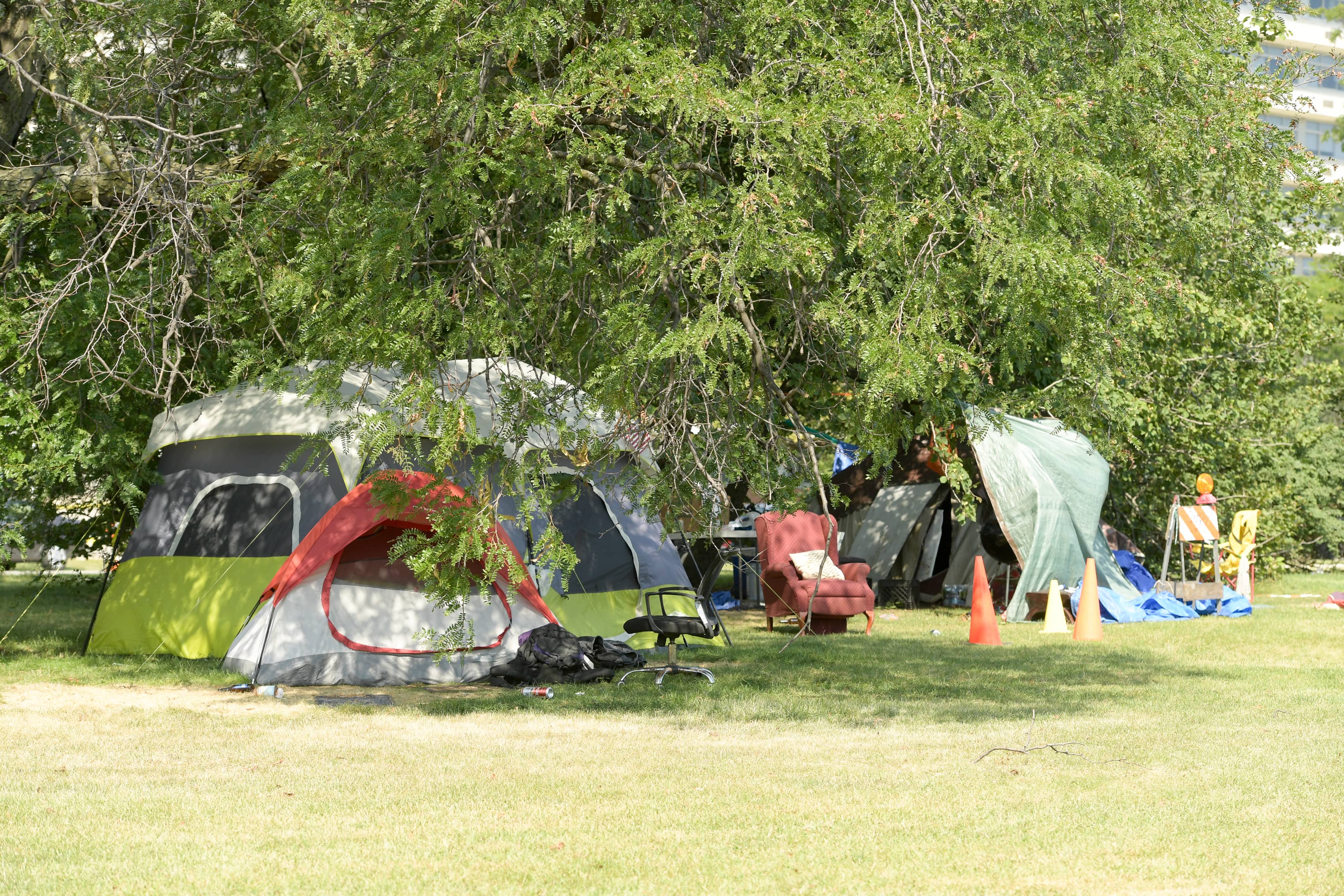
In an editorial by the Chicago Tribune, Chicago Fire Department Deputy District Chief Kelly Burns said the constant threat of fires in these encampments is only made more dangerous because so many of the homeless people are storing propane tanks in their tents.
"It’s tents, wood, open flames, I mean it’s kind of a recipe for disaster," Burns said.
The Tribune rightly points out: "Policies that make enforcement slower and more difficult don’t eliminate encampments, they tend to entrench them." HB 1429 will make these dangerous, sprawling tent cities even worse.
The Trib editorial board adds that Illinois doesn't need more rules for these encampments and, instead, should enforce the rules they are already ignoring by allowing them to spring up in the first place.
"Chicago already has rules on the books governing many of the conditions now seen in encampments. Open fires and the use of propane or other fuel sources are generally prohibited in parks without permission. City rules prohibit unsafe or unpermitted structures that pose risks to public safety, and sanitation laws bar the accumulation of waste that contributes to pollution, fire hazards and rodent infestations," the Tribune editorial board wrote.
The paper added, "Parks are supposed to be closed overnight, typically between 11 p.m. and 6 a.m., and erecting tents or other structures without permission is not allowed. While enforcement is often complicated by legal and practical constraints, these regulations provide the city with tools to address dangerous conditions."
It concludes that "failing to enforce even basic safety rules is a major reason why the problem has gotten so bad here," but HB 1429 would make the situation worse by taking away from local municipalities any ability to control or root out the encampments.
While the Tribune rightly warns of how Chicago parks could decline and become unsafe, Chicago Park District General Superintendent and CEO Carlos Ramirez-Rosa has said little on the draft law. A bombastic socialist, Ramirez-Rosa assumed office last April, and almost immediately emphasized the need to address homelessness. An odd issue to mention upon becoming CEO of the city's Park District, Ramirez-Rosa's silence on HB 1492 is telling. Though Ramirez-Rosa has largely faded from public view since his appointment, he has quietly instituted changes that are certain to start a downward trend in the quality of our parks.
Although there are few known changes, a playground has been named after an armed man shot dead in 2014. While our parks are critical public assets providing intrinsic environmental, aesthetic, and recreation benefits to the public, the naming of a playground for a man shot by Chicago Police and his silence on HB 1492 reveals Ramirez-Rosa intends to politicize our parks.
Illinoisans should call their representatives and urge them to vote "no" on HB 1429.
Follow Warner Todd Huston on Facebook at: Warner Todd Huston | Facebook, X at @WTHuston, or Truth Social at @WarnerToddHuston.
