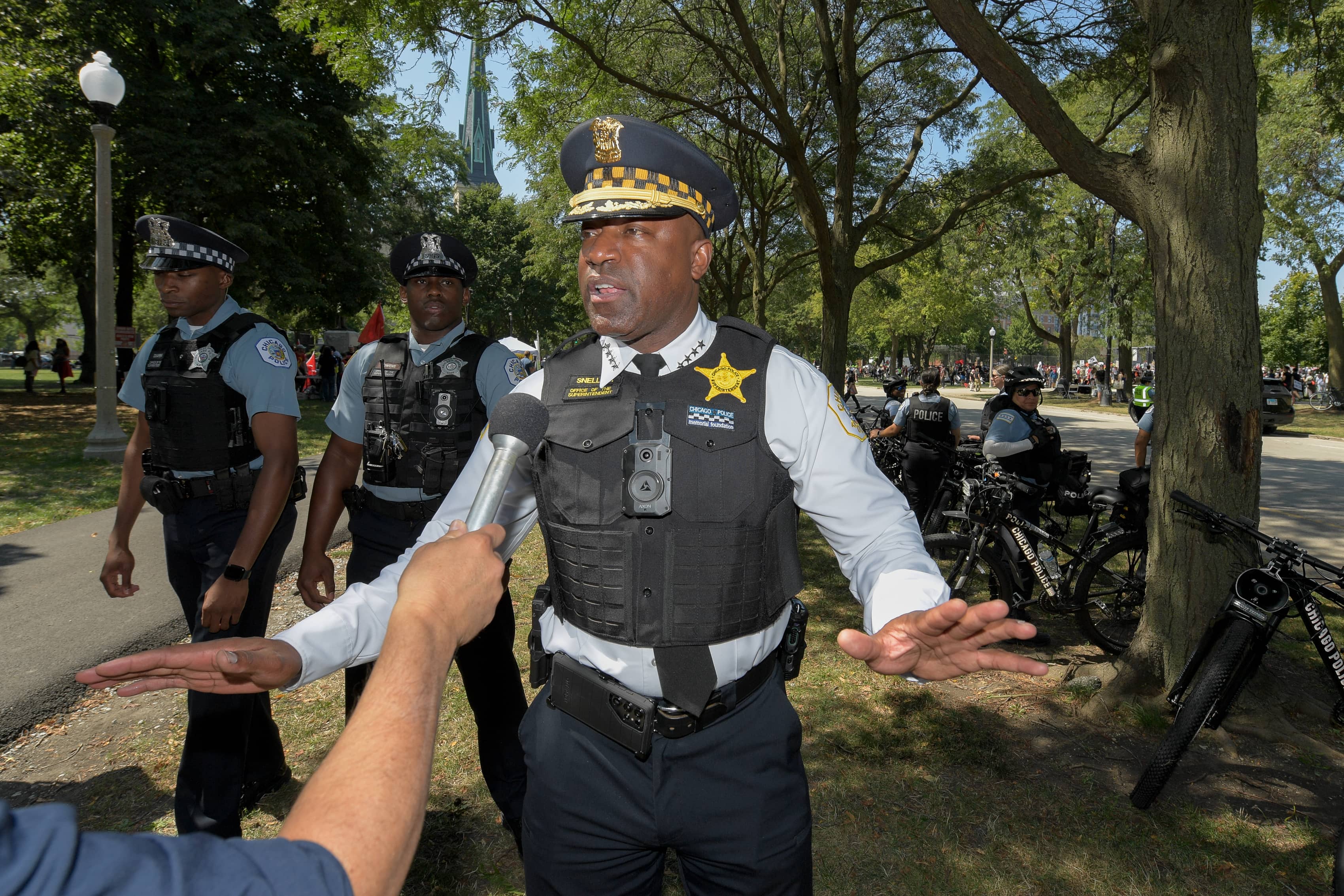
How Chicago’s Larry Snelling became a great American hero
For much of the 20th century, protests in America were an eruption. A protest did not need planning memos, text chains, donor spreadsheets, professionally minted signs, or employees waiting for their next assignment. A protest arose organically due to circumstances that became unbearable. When black Americans marched in Selma, Birmingham, and Montgomery, they did so because they were mad as hell and they weren’t going to take it anymore. When young Americans filled campuses and city squares during the Vietnam War, they were not expressing an abstract opinion. They were trying to avoid getting their rear ends blown off for a cause that was not properly articulated or executed.
When injustice becomes personal, it produces its own infrastructure. Churches, families, universities, and neighborhoods became mobilizing engines without any central command. Leaders emerged because crowds demanded them, not because foundations or wealthy individuals (George Soros anyone?) paid them. The Civil Rights Movement and the Anti-war Movement were not “built.” They were unleashed. Today’s protests feel different because they are different.
Modern American protest has been professionalized, outsourced, and monetized. What once erupted now gets scheduled. What once spread by word of mouth now moves through Slack channels. What once depended on moral urgency now depends on logistics, funding, and media choreography. The change has been gradual but profound, and it helps explain why so many Americans increasingly sense that today’s protest culture feels hollow, manufactured, or disconnected from reality.
Today’s cause du jour is the treatment of illegal immigrants. During the Biden administration at least 10 million illegal immigrants crossed the border completely unchallenged and, in many cases, aided by the federal government. It was really a thinly veiled voter registration drive for the Democratic Party. The Democratic Party struck back at restraining further illegal immigration, as well as deporting illegals, with a sanctuary city movement. Illinois Governor JB Pritzker and Chicago mayors Lori Lightfoot and Brandon Johnson are loyal foot soldiers in the movement. This meant Chicago would refuse to cooperate with the Immigration and Customs Enforcement (ICE). There have been many protests in Broadview, Illinois, where there is an ICE processing center. There also have been plenty of protests in downtown Chicago and the Pilsen neighborhood of Chicago. Any cooperation with ICE and the Chicago Police Department is minimal.
We can first look at how other cities around the country are handling the manufactured protests. ICE’s main function now is rounding up hardened criminals for deportation. In Portland, Oregon, “alleged” members of Tren de Aragua gang were shot and injured. Bob Day, Portland police chief, broke down in tears and apologized to the Hispanic community. Would he have been weeping if it was an ICE agent who had been shot? I doubt it, not to mention the condescending behavior to the Hispanic community, as though they are fans of gang members.
Minneapolis is the main city drawing attention to protest movement. Governor Waltz is encouraging citizens to constantly monitor ICE and do anything to resist their duty to carry out the law. He is also threatening to use the Minnesota National Guard against ICE. Mayor Jacob Frey is equally obnoxious. In Seattle, Mayor Katie Wilson stood next to a protester with a sign that said, “Nazis own flammable cars.” The picture was posted on the mayor’s X account.
How has the city of Chicago responded to civic unrest? We should start by looking at CPD Chief Larry Snelling’s biography. Snelling grew up in Chicago’s Englewood neighborhood. He has over 30 years with the CPD, progressed from patrol officer to senior command roles, and eventually, superintendent. His roles have spanned street policing, training academy instruction, district command, and specialized counterterrorism leadership, providing him with a diversified leadership background. Since 2023, he has led CPD through ongoing reform efforts, crime fluctuations, and public safety challenges.
Have you noticed anything about Larry Snelling? He appears to be totally apolitical. He’s a cop through and through.
Here are a couple of snippets from Larry Snelling’s recent speech.
“If you box them (ICE) in with vehicles, it is reasonable for them to believe that they are being ambushed and that this could end in a deadly situation. And it’s reasonable for them to use force based on those conditions. Do not box in any law enforcement officer. You are breaking the law when you do that, and you are putting yourself in danger."
“If you ram any vehicle, especially one that contains law enforcement agents… and you do this intentionally, this is considered deadly force. Deadly force is anything that can cause great bodily harm or death. When you plow into a vehicle that contains law enforcement agents, you are using deadly force. And they can use deadly force in response to stop you.”
Snelling did not speak in the language of empathy or political solidarity. He spoke in the language of operations. Snelling warned protesters not to box in federal vehicles, not to obstruct law enforcement, not to use vehicles or physical formations in ways that could be interpreted as deadly force. His remarks were widely portrayed as insensitive or authoritarian. What they really revealed was something else: Snelling was not addressing a spontaneous crowd. He was addressing a system. This does not necessarily mean participants are insincere. Many are hired hands and many of them are lost souls who may have mental problems. The irresponsible politicians are putting them in harm’s way.
In Minneapolis and Portland, leaders responded to recent protests by condemning federal actions and emphasizing civil liberties. Their language reflects a belief the crowd represented authentic outrage against perceived injustice. Chicago’s police chief took a different view. He treated the crowd not as a moral force, but as a tactical one.
The protest has become content. It must be filmed, clipped, branded, and pushed into the social media bloodstream. It must generate outrage cycles, fundraising appeals, and press coverage. It must feed the nonprofit-industrial complex that now surrounds political activism.
This is not entirely corrupt. Movements need money. Organizers need to eat. Lawyers cost money. But when protest becomes a job, it ceases to be a spontaneous expression of public will. It becomes an instrument of influence. That shift explains the public’s growing skepticism. Americans can sense when something is real. They can also sense when it is being produced. The marches of the 1960s felt like earthquakes. The protests of today often feel like stage shows.
Snelling’s speech pierced that illusion. By addressing protest tactics rather than protest ideals, he implicitly acknowledged what he was facing was not simply a crowd, but an operation. And operations respond to rules, not rhetoric.
The danger is not that modern protests are fake. It is that they are no longer rooted primarily in personal, unavoidable grievance. They are rooted in networks, incentives, and professional mobilization. That makes them more powerful in some ways, but also less honest. The Civil Rights Movement did not need donors to create urgency. The Vietnam War did not need organizers to generate outrage. Their causes hit home. Today’s movements often do not. They are top heavy political operations masquerading as a movement.
Larry Snelling made a courageous stand on the side of the law. Without the law there is anarchy, not freedom. Larry Snelling is Chicago’s true American hero.
